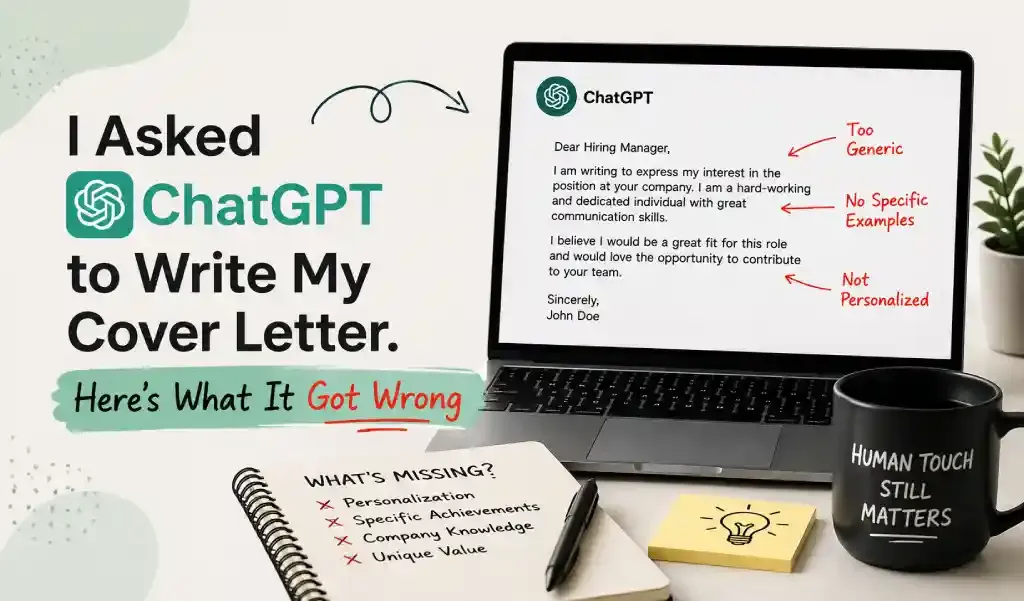
I gave ChatGPT one job posting and one instruction: write me a cover letter. Then I ran it six more times, tweaking the prompt each round. The first draft came back in seconds. It was also full of problems I didn't expect.
Quick answer: ChatGPT wrote a fluent, well-structured cover letter almost instantly. It also invented a skill I never mentioned, opened with a line I'd already seen elsewhere, and echoed the job posting back at me instead of connecting it to my actual experience. Speed was never the issue. Substance was.
Here's the full breakdown.
Key Takeaways
- ChatGPT can draft a cover letter in seconds. It can't verify facts about you.
- Vague prompts produce invented details. One documented test found ChatGPT adding a skill a candidate never mentioned.
- AI cover letters often share the same structure and similar phrasing, letter after letter.
- The generic opening line and common buzzwords are the fastest way to blend in.
- The fix isn't avoiding AI. It's feeding it better, more specific input.
This isn't a niche problem. Use of AI in applications has grown fast enough that we broke down the full adoption numbers separately in our cover letter and resume statistics roundup.
The Prompt I Used
I kept it simple on purpose, the way most people actually do it.
I pasted a real job posting for a marketing coordinator role, then added one line: "Write a cover letter for this job." No resume. No company research. No tone guidance.
That's the test most job seekers unknowingly run every day. It's also exactly the setup that produces the worst version of an AI cover letter.
Mistake #1: It Invented Things I Never Told It
The draft claimed I had "proven experience managing multi-channel campaigns." I hadn't given ChatGPT any campaign experience to describe.
This isn't a one-off glitch. A cover letter experiment run by Forage found the same pattern. When prompts stay vague, ChatGPT fills the gap itself. Their test produced a fabricated software proficiency the candidate never mentioned at all.
The model isn't lying on purpose. It's completing a pattern. A cover letter needs specific claims, so it generates specific-sounding ones, true or not. That's exactly the kind of detail that falls apart the moment an interviewer asks a follow-up question.
Mistake #2: Every Draft Read Like the Same Five Paragraphs
I regenerated the letter several times. The shape never changed. Intro, two body paragraphs, a values paragraph, a closing ask.
A Boston University professor who reviews real applications has described this exact pattern: many run five paragraphs long, with strikingly similar language across different applicants. When thousands of candidates use the same tool with the same default settings, they tend to get the same shape back.
That sameness is invisible to the person sending one letter. It's obvious to a recruiter reading fifty.
Mistake #3: The Opening Line Felt Familiar
My draft opened with some version of "I am writing to express my strong interest in the Marketing Coordinator position." So does nearly every other AI-generated letter. It's the model's default fallback for a vague prompt.
The buzzwords weren't far behind: passionate, results-driven, dynamic, proven track record, leverage. None of these describe anything specific. They just fill space where a real example should sit.
One career coach summed up the underlying issue well: "AIs are brilliant at being average," says Neil Taylor, founder of the communications firm Schwa. That's exactly why the output blends in instead of standing out.
Mistake #4: It Repeated the Job Posting Back at Me
When I pasted more of the job description into a later attempt, the letter improved, but not the way I'd hoped. It echoed phrases straight from the posting instead of connecting them to my background.
That matches what the Forage researchers found in their own testing. ChatGPT can mirror keywords from a job description without explaining why they apply to the candidate. Repeating a phrase isn't the same as making a case for it.
What ChatGPT Actually Got Right
To be fair, not everything failed.
The grammar was clean. The structure, while repetitive across drafts, stayed logical within any single letter. And it solved the blank-page problem instantly, which matters more than people admit when a deadline is an hour away.
Treated as a rough first draft rather than a finished letter, it's a genuinely useful starting point. One coach rated typical unedited ChatGPT output around a B-minus. That's a fair grade for a first pass nobody has to write from scratch.
The Fix That Actually Worked
All four mistakes trace back to one root cause. The model had almost nothing to work with.
Once I added my real resume, the target company's name, and two actual achievements, the fabrication disappeared. The tone sharpened. The letter started sounding like a candidate instead of a template.
That's the real lesson. AI cover letters don't fail because the model is bad. They fail because most people, myself included on that first try, give it almost nothing to build from.
That's also the gap a purpose-built tool closes by default. Cover Letter AI & Resume Maker starts from your actual resume and the specific job post instead of a blank chat window, so there's less empty space left for the model to fill with a guess. You still read it, edit it, and add your own voice. But the starting point is your real background, not an improvisation.
For the edits worth making no matter which tool drafts the letter, our guide on personalizing AI-generated cover letters walks through each one. To see what a genuinely tailored letter looks like once those fixes are made, we collected real examples in winning cover letter examples that got jobs.
Frequently Asked Questions
Does ChatGPT make up fake experience in cover letters? Yes, when prompts are vague. Documented testing has found ChatGPT inventing skills or achievements a candidate never mentioned, simply to complete the letter's structure.
Why do AI cover letters all sound the same? Default prompts produce default output. Most people paste a job posting with no resume or context, so ChatGPT falls back on the same structure, tone, and phrasing for everyone.
Is it bad to use ChatGPT for a cover letter? No, but treat it as a first draft. The mistakes above come from sending the output unedited, not from using AI itself.
What should I add to my prompt to get a better result? Your actual resume, the full job description, and at least two specific, real achievements. Specific input produces specific output.
How do I fix a generic AI-written cover letter? Remove buzzwords, add real numbers, mention something true about the company, and rewrite the opening line so it isn't the same one every other applicant sent too.