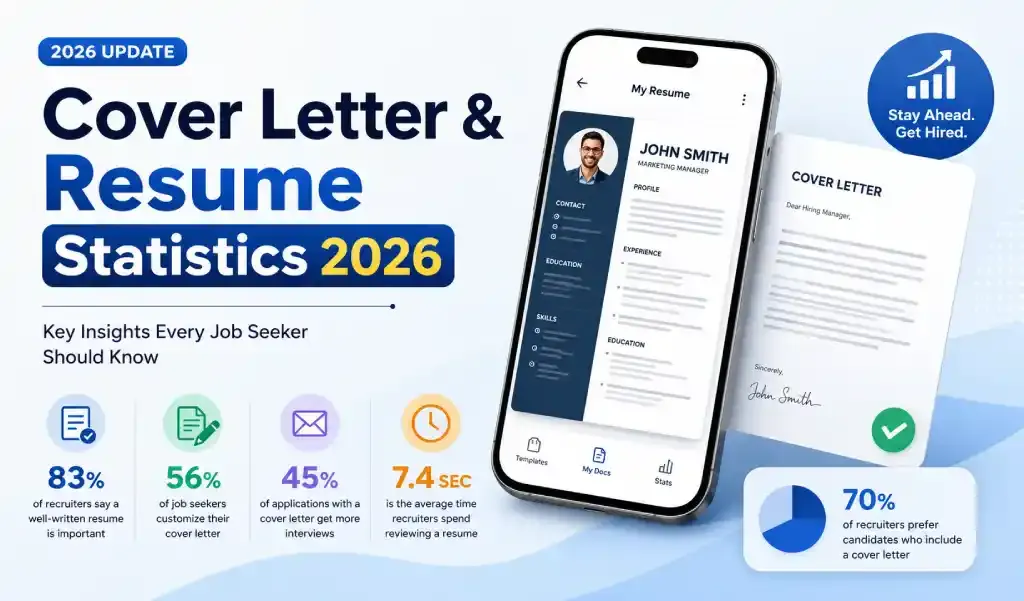
Most job search advice is opinion. This post is not.
Below are the most important cover letter and resume statistics for 2026, pulled from hiring manager surveys, recruiter studies, and real application data. Use them to decide where your effort actually pays off.
Quick answer: In 2026, 83% of hiring managers still read cover letters, around 99% of Fortune 500 companies screen resumes with ATS software, and tailored applications earn roughly 50% more callbacks than generic ones. Customization, not credentials alone, is the biggest lever most job seekers ignore.
Now let's break the numbers down.
Key Takeaways
- 83% of hiring managers read cover letters, even when they are optional.
- 94% say a cover letter influences who gets an interview.
- Nearly 99% of Fortune 500 companies use ATS software to filter resumes.
- A tailored cover letter lifted callbacks to 16.4% in a field study. A generic one managed just 12.5%.
- 83% of companies plan to use AI to review resumes in 2026.
Do Hiring Managers Still Read Cover Letters in 2026?
Yes. The data is surprisingly one-sided.
A Resume Genius survey of 625 U.S. hiring managers found that 83% read most cover letters they receive. That holds even at companies where a letter is not required.
It gets more interesting. In the same survey, 45% of hiring managers said they read the cover letter before the resume. Your letter is often the first impression, not the afterthought.
And the stakes are real. 94% of hiring managers say cover letters influence their interview decisions. One in four calls them "very important."
We covered the human side of this in our post on whether recruiters still read cover letters. The short version: skipping the letter is a gamble you don't need to take.
Cover Letter Statistics That Should Change How You Apply
Here are the numbers worth acting on:
- 72% of hiring managers expect a cover letter even when the posting says "optional." Treat optional as required.
- A field study of over 7,000 applications found tailored cover letters earned a 16.4% callback rate. Generic letters got 12.5%. No letter at all got 10.7%.
- 81% of recruiters have rejected candidates based on their cover letter alone (Zety).
- Applicants who include a cover letter are 3.4x more likely to land an interview, according to Jobscan's State of the Job Search report.
Notice the pattern. The cover letter itself is not the edge. The tailored cover letter is. A copy-paste letter barely beats sending nothing.
That is the real bottleneck for most job seekers. Tailoring one letter takes 30 to 60 minutes. Applying to 20 jobs means 20 rewrites. This is exactly the gap AI tools now close. An app like Cover Letter AI & Resume Maker generates a job-specific draft in seconds, so the time cost of tailoring stops being the reason you send a generic letter. You still add the personal touches. We explain how in our guide to personalizing AI-generated cover letters.
Resume Statistics 2026: The ATS Filter Is Real
Before a human reads your resume, software usually does.
- Nearly 99% of Fortune 500 companies use an Applicant Tracking System (ATS) to manage and screen applications (Jobscan).
- Around 75% of resumes are filtered out before a recruiter ever sees them, often due to missing keywords or formatting the software cannot parse.
- Resumes with tables, graphics, or multi-column layouts can lose half their content during ATS parsing.
- The average corporate job posting attracts 250+ applications (Glassdoor).
The lesson is simple. A beautiful resume that an ATS cannot read is an invisible resume. Clean structure, standard headings, and job-matched keywords come first. Design comes second.
Our breakdown of the most important resume sections shows how to structure a resume that both software and humans can scan fast.
How Long Do Recruiters Actually Look at Your Resume?
You have probably heard "7 seconds." The truth is messier.
The famous 6 to 7 second figure comes from a 2012 Ladders eye-tracking study with only 25 participants. Newer research, including replication studies compiled by Novoresume, suggests the first pass is often closer to 17 to 46 seconds.
Either way, the practical advice does not change. Recruiters skim. They look at job titles, companies, dates, and results.
What earns a longer look?
- 75% of hiring managers want quantified achievements, not duty lists (LinkedIn).
- 83% of recruiters say they are more likely to hire candidates with a well-formatted resume (Jobvite).
- 61% of hiring managers say a tailored resume is the single best way to improve your chances (Zippia).
There it is again: tailoring. The same lever, twice.
AI in Hiring: The 2026 Numbers
AI now sits on both sides of the hiring table.
On the employer side, 83% of companies plan to use AI to review resumes in 2026 (Resume Builder). Screening is faster, stricter, and more keyword-driven than ever.
On the candidate side, the stigma is mostly gone. 90% of hiring managers say it is acceptable to use generative AI for application materials (Canva). The objection was never AI itself. It was lazy, generic output.
So the 2026 playbook looks like this: use AI to draft and structure, then personalize so the final letter sounds like you. We dig deeper into this shift in how AI is changing resume writing in 2026.
What These Statistics Mean for Your Job Search
Pull the numbers together and a clear strategy emerges:
- Always send a cover letter. 72% expect one even when it is optional.
- Tailor everything. Customization roughly triples the benefit of a cover letter and is the top resume factor hiring managers cite.
- Format for ATS first. Simple layout, standard section names, keywords from the job description.
- Quantify your wins. Numbers survive a skim. Adjectives do not.
- Use AI for speed, not as a final draft. Generate, then personalize.
The hard part used to be time. Tailoring 20 applications by hand is a full-time job. Tools have removed that excuse. Whether you use our app or write manually, the data says the tailored applicant wins.
Frequently Asked Questions
Are cover letters still important in 2026? Yes. 83% of hiring managers read them, 94% say they influence interview decisions, and 72% expect one even when it is listed as optional.
What percentage of resumes get rejected by ATS? Roughly 75% of resumes are filtered out by applicant tracking systems before a human reviews them, usually due to missing keywords or unreadable formatting.
Do employers care if my resume or cover letter was written with AI? Mostly no. 90% of hiring managers say using generative AI for application materials is acceptable. What they reject is generic, untailored content.
How long should a cover letter be in 2026? Around 200 to 350 words, or half a page. Hiring managers skim, so a short, tailored letter outperforms a long, generic one.
Does tailoring a resume really increase interview chances? Yes. 61% of hiring managers name tailoring as the best way to improve your odds, and field data shows tailored applications earn significantly more callbacks than generic ones.
Sources: Resume Genius (2026 hiring manager survey), Jobscan, Novoresume, Zety, Glassdoor, Zippia, LinkedIn, Jobvite, Resume Builder, Canva, ResumeGo field study.