 Cover Letter AI & Resume Maker
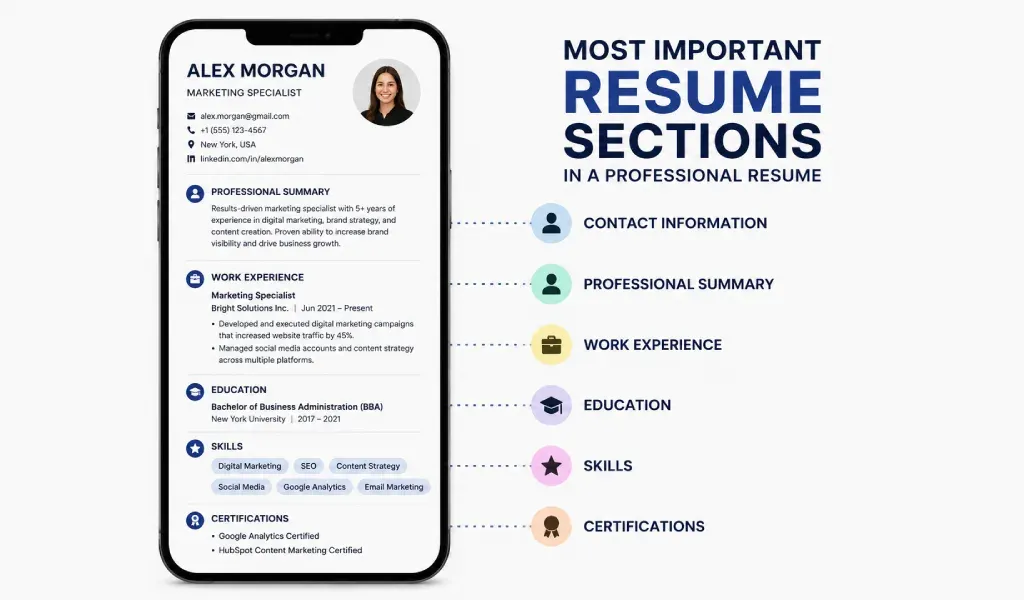
The most important resume sections are your contact details, experience and education, followed by skills and, optionally, a short summary. The right order depends on your stage: students lead with education, mid-career professionals with experience, and career changers with a summary and skills. Below are order tables, an optional-sections guide and a sample outline.
Key Takeaways
- Every resume needs contact details, experience and education. A summary and skills are optional.
- Students lead with education. Mid-career professionals lead with experience.
- Career changers can lead with a short summary and skills, then add experience.
- Add optional sections only when they support the job you want.
- Leave off "references available upon request," personal details and unrelated old jobs.
Which Resume Sections Are Essential?
UC Davis's career center lists the header, education and experience as the core of a resume. Indiana State University's career center treats an objective or summary, and a skills section, as optional. For the full walk-through, see how to write a resume.
| Section | What goes in it | Essential? |
|---|---|---|
| Header | Name, city and state, phone, email | Yes |
| Experience | Jobs, internships and relevant volunteering, newest first | Yes |
| Education | Degree, school, graduation date | Yes |
| Summary | One to three lines on what you offer | Optional |
| Skills | Hard skills grouped by category | Optional |
| Projects, certifications, activities | Extras that support the target job | Optional |
In What Order Should Resume Sections Go?
It depends on your stage. Pick the order that shows your best qualifications first.
| Your stage | Suggested order | Why |
|---|---|---|
| Student or recent graduate | Header, Education, Experience (internships and projects), Skills, Activities | UC Davis lists education before experience, and the SIUC Writing Center says new graduates may move education to the top |
| Mid-career professional | Header, Summary (optional), Experience, Education, Skills | SIUC's recommended layout runs header, profile, work history emphasizing the past 10 to 15 years, then education |
| Career changer | Header, Summary, Skills, Experience, Education | UNLV describes a hybrid format that leads with a short summary of skills and strengths before a traditional experience section |
James Madison University's career center describes a combination format that gives equal emphasis to experience and skills. If you are a fresher, see the resume format for freshers guide for layouts and country notes.
Want a starting layout? Cover Letter AI & Resume Maker has several resume templates and fonts for iPhone and iPad. Enter your own details and export a PDF.
Which Optional Sections Are Worth Adding?
Add a section when it supports the job you want. Skip it when it only fills space.
| Section | Add it when | Note |
|---|---|---|
| Summary | You have some experience, or need to connect a career change | One to three lines, without "I." Indiana State says to skip it if you also send a cover letter. See how to write a resume summary |
| Skills | Hard skills matter for the job | Indiana State suggests focusing on hard skills and avoiding terms like "hard worker." See how to show skills on a resume |
| Projects | You have little work history, or the field values them | Describe your role and the result |
| Certifications and licenses | The posting asks for them, or they relate to the job | Georgetown lists licenses and certifications as sections to consider |
| Activities and volunteering | They show relevant skills or leadership | Georgetown suggests naming leadership roles and keeping descriptions short |
| Honors and awards | They are relevant or notable | Georgetown suggests little or no description |
| Languages | The job values them | Georgetown suggests labeling the level, such as conversational or fluent |
| Publications, patents, affiliations | Academic, research or professional fields | The SIUC handout lists them as optional sections |
What Should You Leave Off a Resume?
- "References available upon request." Georgetown and the SIUC Writing Center both say to omit it. Prepare a separate reference page instead.
- Personal details and photos. In U.S. applications, career centers advise leaving off items such as age, marital status and photos. Norms differ by country, so check the posting.
- A low GPA. Georgetown suggests listing GPA only if it is above 3.00.
- Unrelated or very old jobs. SIUC's layout emphasizes the past 10 to 15 years of work history.
- Extra pages. Our guide on resume length explains when one page is enough.
What Does a Sample Resume Outline Look Like?
Use this as a guide, reorder it for your stage and delete what does not apply.
[FULL NAME]
[City, State] | [Phone] | [Email] | [LinkedIn URL, optional]

SUMMARY (optional, one to three lines)
[Role] with [number] years in [focus]. [Proof]. [Goal].

EXPERIENCE
[Job Title], [Employer], [City, State]            [Month Year] to [Month Year]
- [Action verb] + [what you did] + [result]
- [Different action verb] + [task] + [result]

EDUCATION
[Degree], [School], [Year]

SKILLS (optional)
[Category]: [skill], [skill], [skill]

OPTIONAL: Projects | Certifications | Activities and volunteering | Honors | Languages
For students, move EDUCATION above EXPERIENCE. For career changers, put SUMMARY and SKILLS first.
Related Reading
- How to Write a Resume in 2026: A Step-by-Step Guide: the step-by-step guide to the whole resume.
- How to Write a Strong Resume Summary (With 10 Examples): a formula and ten examples.
- How to Show Your Skills on a Resume (With Examples): show hard and soft skills with proof.
- Should a Resume Be One Page? Here's the Real Answer: when one page is enough and when it is not.
Sources: UC Davis Career Center, "Resumes"; Indiana State University Career Center, "Résumé Writing Guide"; Georgetown University Career Center, "Resume Content & Formatting"; SIUC Writing Center, résumé format handout; UNLV Career Services, "How to Handle a Resume Gap"; James Madison University Career Center, résumé formats and formatting.
Ready to build yours? Cover Letter AI & Resume Maker turns the details you enter into a resume draft you can edit and export. Free to download from the App Store for iPhone and iPad, with in-app purchases for some features. AI drafts can contain mistakes, so read and edit every line before you send it.
Frequently Asked Questions
What are the main sections of a resume? Contact details, experience and education, in that core. UC Davis's career center lists the header, education and experience as the basics. Skills, a summary, projects, certifications, volunteering and honors are optional, and you should add them only when they support the job.
In what order should resume sections go? Lead with your strongest qualifications. Students usually put education before experience, mid-career professionals lead with experience, and career changers can open with a short summary and skills. In every case, list jobs newest first within the experience section.
Do I need a summary or objective? No. Indiana State treats an objective or summary as optional, at one to three lines, and says to skip it if you also send a cover letter. If you use one, focus on what you offer the employer. See how to write a resume summary.
Should I include references on a resume? No. Georgetown's career center and the SIUC Writing Center both say to leave off "references available upon request." Prepare a separate reference page with names, titles and contact details, and share it when an employer asks.