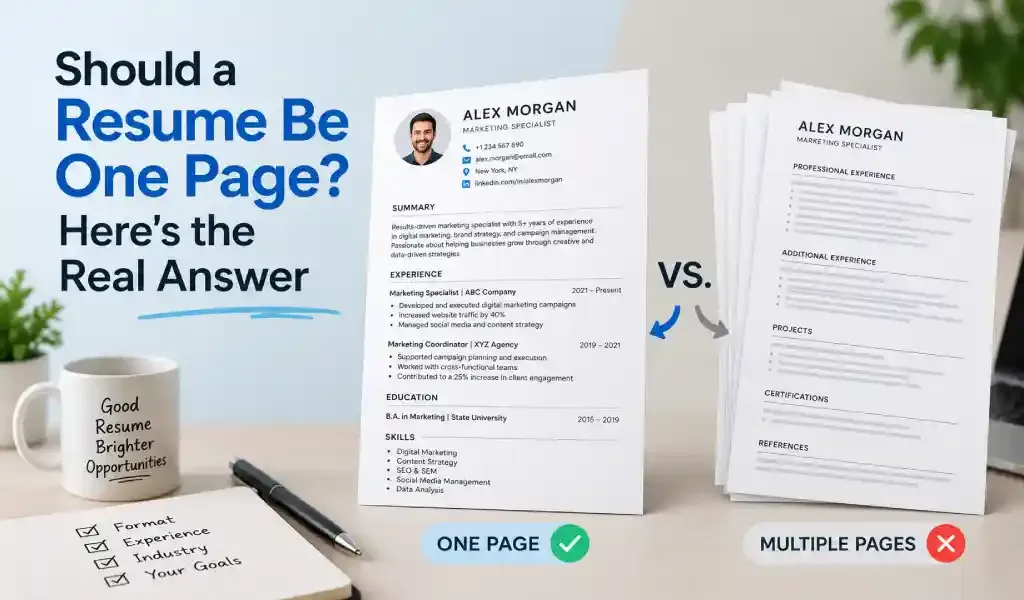
You've heard both rules. Keep it to one page. Two pages is fine now.
Quick answer: For most early-career candidates, yes, one page. Past roughly 7 to 10 years of relevant experience, two pages is normal and often expected. The strict, one-size-fits-all rule is gone. What actually matters is your experience level, how relevant each line is, and how tightly you edit, not a fixed page count.
Here's where the number actually comes from, and what to do with it.
Key Takeaways
- The "always one page" rule is no longer the majority view among hiring managers.
- Experience level, not tradition, should decide your length.
- ATS software does not penalize a second page. Weak keyword matching hurts you either way.
- Academic, research, and U.S. federal resumes follow completely different length rules.
- The real question isn't page count. It's whether every line earns its place.
Where the One-Page Rule Actually Came From
The rule made sense once. Resumes were printed and handed across a desk. Recruiters skimmed a stack by hand between meetings. One page was simply what fit the moment, and what a busy hiring manager could realistically hold onto.
That world is mostly gone. Most resumes today are opened on a screen, often inside an ATS dashboard that scrolls without effort. Scrolling costs nothing the way flipping a printed page once did. The physical constraint that created the rule doesn't really apply anymore, but the habit outlived the reason for it, the way a lot of career advice does.
What Hiring Managers Actually Say in 2026
Recent surveys don't agree on an exact number, but they agree on the direction.
Monster's 2026 State of the Resume report, based on over 1,000 U.S. job seekers, found 49% now submit resumes longer than one page. That would have been unusual a decade ago.
On the hiring side, a Zippia and Resume Genius survey of 500+ hiring managers found 77% prefer one to two pages, split clearly by experience. Candidates under 10 years, one page wins. Past that, two pages is the majority preference.
Different surveys land on different exact percentages. The pattern underneath them doesn't move: length preference tracks experience, not a fixed rule.
None of this changes how fast the first look happens, though. Recruiters still scan a new resume in seconds before deciding whether to read on, something we cover in our post on common resume mistakes. A second page only helps if the first one already earns a closer look.
Does Resume Length Affect ATS Scoring?
No. This is the part most advice gets wrong.
Applicant tracking software parses text and matches keywords. It does not count pages and penalize you for a second one. Multiple resume-length analyses confirm this directly: ATS systems do not care about page count.
What actually hurts you in an ATS is the same thing regardless of length: missing keywords from the job description, unusual formatting, or a layout the software can't parse. We cover the formatting side in our guide on what makes a resume ATS-friendly.
So a well-edited two-page resume is not riskier than a one-page one. A padded one-page resume with weak keywords is riskier than both.
So How Long Should Your Resume Actually Be?
Match the length to where you actually are.
| Career Stage | Recommended Length |
|---|---|
| Student or entry-level (0–3 years) | 1 page |
| Mid-career (3–7 years) | 1 page, 2 if it's earned |
| Senior or 10+ years experience | 2 pages |
| Executive or C-suite | 2 pages |
| Academic or research CV | No fixed limit |
| U.S. federal applications | Up to 2 pages (USAJobs limit) |
Two exceptions are worth knowing. Academic CVs run much longer than any resume; a five-page CV with a full publication list is normal for a PhD. And U.S. federal roles cap out at two pages by policy, regardless of experience.
Location matters too. This table reflects U.S. norms. In the UK and Australia, a two or even three-page CV is standard practice at almost any experience level, so don't force a two-page career history into one page just because that's the American convention.
If you're just starting out, our guide on writing a resume with no experience covers exactly how to fill one strong page.
The Real Test: Does Every Line Earn Its Place?
Page count is the wrong question to obsess over. Relevance is the right one.
A one-page resume padded with a hobbies section and a summary that says nothing is worse than a tight two-pager full of results. A two-page resume that repeats itself is worse than a focused single page. Neither problem gets fixed by counting pages.
The real filter is simple: would a recruiter miss this line if you cut it? If not, cut it. A few lines rarely survive that test:
- An objective statement that could belong to any candidate.
- "References available upon request." Recruiters already assume this.
- Jobs from 15+ years ago with no relevance to the role.
- Skills everyone in your field already has, listed just to fill space.
Our breakdown of the most important resume sections walks through what's actually worth the space instead.
This is also where starting from your real history helps more than a blank template. A generic template invites you to fill every section, whether or not it's relevant to the job. A tool that builds from your actual experience and the specific listing you're applying to, like Cover Letter AI & Resume Maker, surfaces what's relevant to that job instead of everything you've ever done. That's what naturally produces the right length. One page when one page holds everything that matters. Two when it doesn't.
Frequently Asked Questions
Is a two-page resume ever acceptable? Yes. Most surveys now show a majority of hiring managers accept, or prefer, two pages for candidates with 10 or more years of relevant experience.
Does a longer resume hurt my chances with ATS software? No. ATS systems match keywords and parse formatting. They do not penalize a resume for having two pages instead of one.
How long should a resume be with no work experience? One page. Focus on education, projects, and transferable skills rather than stretching content to fill space.
Is it better to have a full two pages or a page and a half? A full two pages. A resume that's one and a quarter or one and a half pages often reads as unfinished. Either fill the second page properly or trim back to one.
Are academic CVs the same as resumes? No. Academic and research CVs have no standard page limit and commonly run several pages once publications and presentations are included.