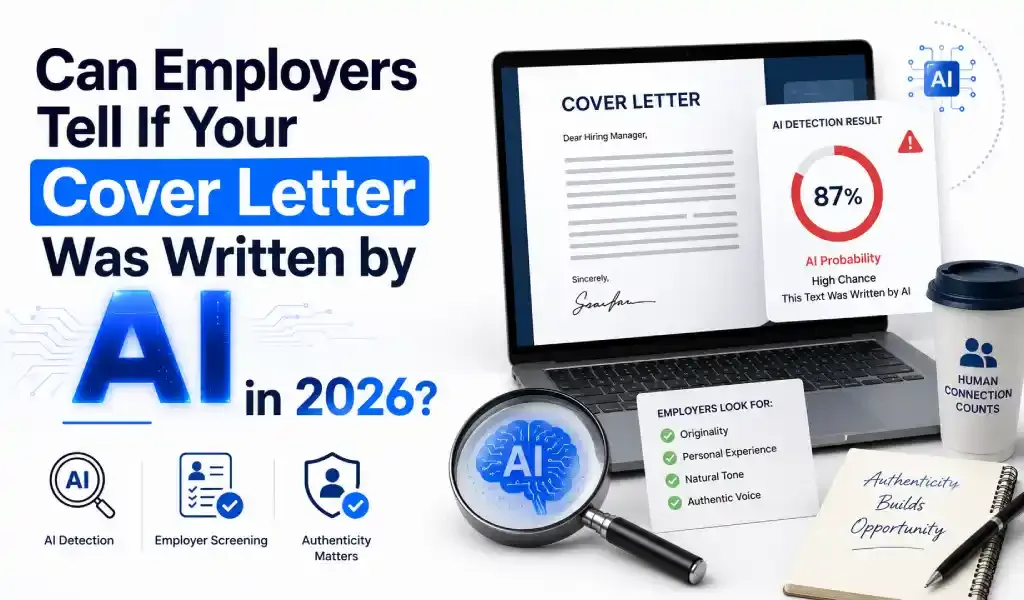
Millions of job seekers type some version of this question before hitting send.
Quick answer: Usually not with certainty. AI-detection software is unreliable. But recruiters don't need software. They notice generic phrasing, recycled buzzwords, and a letter that could go to any company. That pattern gets flagged, whether or not AI actually wrote it. The real risk isn't getting caught. It's sounding like everyone else.
Here's what the data actually shows.
Key Takeaways
- Around 29% of job seekers used AI to write or edit a cover letter in the past year, up from 17% in 2024 (iHire).
- 33.5% of hiring managers say they can spot an AI-written application in under 20 seconds (TopResume).
- Dedicated AI detectors misfire often. Recruiters rely on pattern recognition instead.
- Words like "delve," "leverage," "tapestry," and "unwavering" now read as instant AI flags.
- Personalization decides the outcome. Not whether AI touched the first draft.
Do Employers Actually Run Letters Through an AI Detector?
Rarely. And when they do, the results aren't trustworthy.
This question exists because AI writing has gone mainstream on both sides of hiring. An iHire survey of over 1,400 job seekers found 29.3% had used AI to write or customize a resume or cover letter in the past year, up from 17.3% the year before. AIApply's coverage of the report breaks down the full numbers.
Independent testing shows AI-detection tools misfire often. They flag human writing as AI-generated. They miss real AI text completely. Big Interview's own team has said as much: there's no reliable way to detect AI content in a cover letter today.
That doesn't mean employers are unaffected. A Robert Half survey of 2,000 U.S. hiring managers found 67% say reviewing AI-generated applications has slowed down hiring. 65% say it's now harder to verify a candidate's real skills.
So employers adapt differently. Instead of scanning for AI, many add steps. More skills tests. More structured interviews. More reference checks. The goal isn't catching AI use. It's verifying the person behind the application.
What Actually Gives You Away (It's Not a Detector)
Recruiters don't need software. They've read thousands of letters. Patterns jump out fast.
Recruiters interviewed by the press describe the same experience. One recruiting manager at Zapier estimated roughly a quarter of applications she sees look AI-generated. A recruitment executive at LHH said the real giveaway is buzzwords used without any real example behind them.
Specific words carry that same red flag. Multiple hiring guides now name the same short list: delve, leverage, synergize, tapestry, pivotal, unwavering, robust, spearheaded, cutting-edge.
Beyond vocabulary, three patterns stand out to hiring managers:
- Same tone everywhere. Resume, cover letter, and any writing sample all read like one corporate blog post.
- Zero quantification. Long, confident sentences with no numbers, no scope, no real detail.
- Could apply to any job. Swap the company name and nothing else needs to change.
A TopResume survey of 600 hiring managers found 33.5% say they can spot an AI-written application in under 20 seconds. They aren't running software. They're pattern-matching.
Why "Generic" Hurts More Than "AI" Does
Here's the reframe that actually matters. Employers aren't hunting for AI. They're hunting for effort.
A Resume.io survey of 3,000 hiring managers found 49% auto-dismiss résumés they suspect are AI-generated. But the real trigger sits one layer deeper. A separate Resume Now survey found 62% specifically reject AI content that lacks personalization, and 90% report a rise in low-effort, AI-driven applications overall.
Nobody was surveyed on rejecting all AI use. They're rejecting the lack of personalization that unedited AI drafts produce. That distinction should change what you do next.
Is It OK to Use AI for a Cover Letter in 2026?
Mostly, yes. The stigma has faded fast.
Most hiring managers now say using generative AI for application materials is acceptable. What they don't accept is a draft sent with zero editing. The objection was never the tool. It was laziness.
What AI can't do on its own is research your target company. As one career advisor put it in a USC Online career guide, genuine company research is what turns a cover letter into a real argument for why you fit. That step is something no generator does for you automatically.
So the working approach for 2026 looks simple: start with AI, finish with yourself.
How to Use AI Without Sounding Like AI
A few edits separate a flagged letter from one that reads as genuinely yours.
- Delete the buzzwords. Search your draft for "delve," "leverage," "tapestry," and similar words. Swap in plain language.
- Add one real number. A metric, a team size, a timeframe. Specifics rarely come from a generic prompt.
- Name something true about the company. A product, a recent announcement, a value from their careers page.
- Vary your sentence length. AI drafts tend toward uniform rhythm. Real writing doesn't.
- Read it out loud. If a line doesn't sound like you talking, rewrite it.
We break each of these down further in our guide on how to personalize AI-generated cover letters.
Starting point matters too. A blank prompt into a general chatbot produces generic output by default, since there's no job description or resume behind it unless you paste one in yourself. A tool built specifically for job applications, like Cover Letter AI & Resume Maker, builds the first draft from your actual resume and the specific job post. That draft still needs your final pass, but it starts from your real details, so there's less generic language to strip out later.
For a look at what a fully personalized letter reads like in practice, see our roundup of winning cover letter examples that got jobs.
The Bigger Picture
AI in hiring is moving in two directions at once. Employers use it to screen. Candidates use it to draft. Neither side is stepping back.
We track this shift further in how AI is changing resume writing in 2026, and in our broader cover letter and resume statistics for 2026.
One takeaway holds steady across all of it. Detection isn't the real risk. Genericness is. Fix that, and the "AI or not" question mostly stops mattering.
Frequently Asked Questions
Can employers tell if I used ChatGPT for my cover letter? Not with certainty. AI-detection software is unreliable and prone to false positives. But hiring managers often spot generic phrasing, repeated buzzwords, and a lack of specific detail, common signs of an unedited AI draft.
What words make a cover letter look AI-written? "Delve," "leverage," "synergize," "tapestry," "pivotal," "unwavering," and "cutting-edge" are the words recruiters flag most often. Replace them with plainer, more specific language.
Will using AI hurt my job application? Not if you personalize it. Most hiring managers accept AI-assisted writing. What hurts applicants is a generic, unedited draft, not the tool itself.
Should I tell an employer I used AI to write my cover letter? Most job postings don't ask. If a company states a clear AI policy, follow it. Otherwise, focus on submitting a personalized, accurate letter, regardless of how the first draft came together.
How do I make an AI-written cover letter sound more human? Remove common AI buzzwords, add one specific number or detail, name something real about the company, and read the letter aloud before sending it.