 Cover Letter AI & Resume Maker
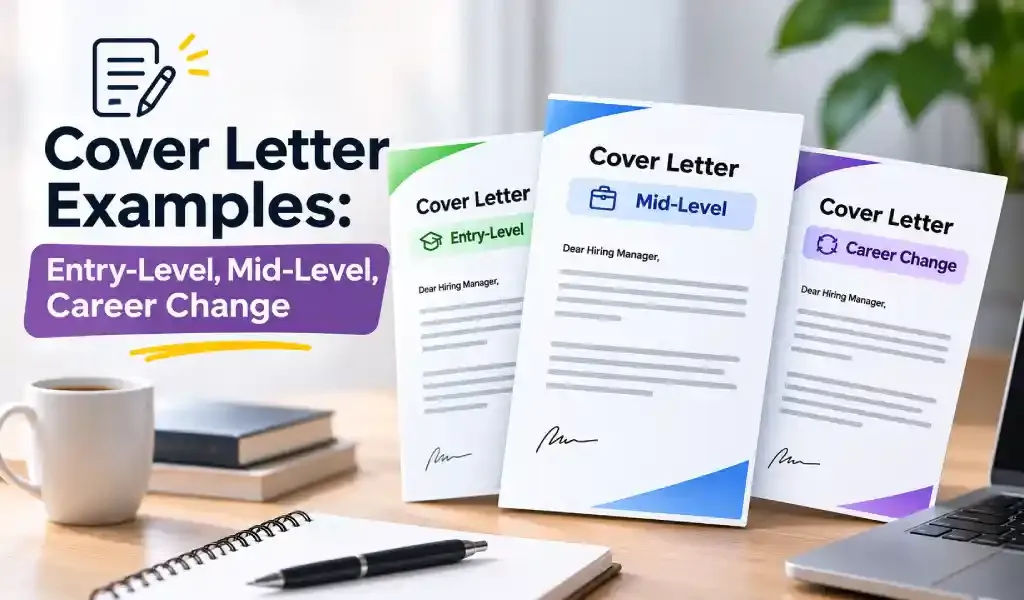
A cover letter changes with your situation. An entry-level letter leans on school, projects and part-time work, a mid-level letter leads with results, a career-change letter explains why your skills transfer, and a letter after a gap keeps the explanation short. Below are four fictional examples, with a checklist of what to swap in each.
Looking for letters by job instead? See our cover letter examples for different jobs. New to the whole process? Start with how to write a cover letter. Applying for an internship? See the internship application letter guide, and if your resume is thin, see how to write a resume with no experience.
Key Takeaways
- Match the letter to your situation: lead with school and projects, results, transferable skills or current skills.
- Career changers should name the change plainly and explain why their skills carry over.
- If you have a gap, mention it in a few sentences and move on to your current skills.
- Replace every [placeholder], and cut any claim you can't back up.
- These samples are fictional models, not text to submit as written.
Entry-Level Cover Letter Example
This sample suits students, new graduates and anyone applying with little paid experience.
Dear [Hiring Manager's Name],
I'm applying for the [Job Title] position at [Company]. I'm graduating from [School] in [month, year] with a degree in [field], and I'm eager to start my career in [industry].
In my [course, project or club], I [specific action], which taught me [relevant skill]. At my part-time job at [Employer], I [responsibility], so I'm used to [skill the job needs, such as working with customers or meeting deadlines]. I also volunteer as [role] at [organization], where I [responsibility].
I read that [Company] is [something specific from the company's website or news], and I would enjoy contributing to that work. I'm a quick learner and take feedback well, and I'd welcome the chance to talk about how I can help your team. Thank you for your time and consideration.
Sincerely,
[Your Name]
What to swap:
- The course, project or club: choose the one closest to the job.
- Your part-time or volunteer work: use it to show reliability and teamwork.
- The line about the company: use a specific detail from its website or news, not general praise.
- The skills: use the words from the job post.
Mid-Level Cover Letter Example
This sample suits someone with several years in the field who wants a bigger role.
Dear [Hiring Manager's Name],
I'm applying for the [Job Title] role at [Company]. Over the past [number] years at [Current Employer], I've [main responsibility], and I'm ready to take on more ownership in a team like yours. I'm known for [strength, for example, clear communication with other teams].
Last year I led [project or initiative], which [measurable result, if you have one]. I also mentored [number] newer colleagues and worked with [other teams] to [shared goal]. The posting mentions [requirement], and that's the kind of work I've done most. I'm comfortable owning [task] from planning through delivery.
I'm especially interested in [Company]'s plans for [goal from the posting], because it builds on my experience with [skill]. I'm confident I can contribute quickly, and I'd welcome the chance to discuss the role. Thank you for your time.
Sincerely,
[Your Name]
What to swap:
- Your biggest result from the past two years, with a number only if you can support it.
- The requirement from the posting that you match most closely.
- Your leadership evidence, such as mentoring, leading a project or training others.
- The company goal in the last paragraph.
How Do You Show Transferable Skills in a Cover Letter?
Start with the job post. Pick the three or four requirements that matter most, then find the same skill in your past work, even if the setting was different. The career guide from the University of Northwestern - St. Paul says to use the cover letter to explain these skills in more depth than a resume allows, and to stress achievements over duties. If you lack a requirement, it says to explain how your other experience makes up for it.
| Past experience | Skill that transfers | How to phrase it |
|---|---|---|
| Restaurant server | Working under pressure, customer service | "I managed [number] tables during peak hours and kept orders accurate." |
| Classroom teacher | Planning, presenting, explaining complex ideas | "I plan and deliver lessons to [number] people with different needs." |
| Retail associate | Sales, inventory, teamwork | "I [specific task] with a team of [number] during our busiest season." |
Short on time? Enter the role, company, tone and your key skills in Cover Letter AI & Resume Maker to get a first draft, then rewrite it in your own voice.
Career Change Cover Letter Example
Say the change plainly, then show how your skills carry over.
Dear [Hiring Manager's Name],
I'm applying for the [New Job Title] position at [Company]. After [number] years in [previous field], I'm moving into [new field], and the skills that made me effective in my current role carry over directly.
At [Current Employer], I [transferable responsibility, for example, managed client relationships and tight deadlines], which is the same work your posting describes as [requirement]. To prepare for this move, I completed [course, certification or project] and [other step, such as a volunteer project in the new field]. I'm drawn to [Company] because [specific reason].
I know my path is not the usual one. I bring a fresh perspective from [previous field] and a willingness to learn quickly, and I'd welcome the chance to meet and explain how my background would help [Company]. Thank you for considering my application.
Sincerely,
[Your Name]
What to swap:
- The two or three skills that appear in both your old job and the new posting.
- Proof you have started: a course, certification, volunteer role or project.
- The first paragraph: name the change without apologizing for it.
- The close: ask for a meeting, as that guide advises.
Cover Letter Example for Returning to Work After a Gap
Keep the explanation brief and move quickly to what you can do now.
Dear [Hiring Manager's Name],
I'm applying for the [Job Title] position at [Company]. I have [number] years of experience in [field], and after [a few years away to care for family, study or relocate], I'm ready to return to full-time work.
During that time I [relevant activity, for example, completed a certification, volunteered as a treasurer or freelanced on small projects], which kept my [skill] current. I've also refreshed my knowledge of [tool or software] so I can start contributing quickly. Before my break, I [key achievement at previous employer], and I would bring the same standards to [Company].
I'm available to start on [date] and can work [schedule], and I'm ready to ramp up quickly. I'd welcome a conversation about the role. Thank you for your time and consideration.
Sincerely,
[Your Name]
What to swap:
- The reason for the gap: one clause, and only what you're comfortable sharing.
- One thing that kept your skills current, such as a course, volunteering or freelance work.
- Your strongest achievement from before the break.
- The tools or software you have refreshed.
UNLV Career Services suggests a few straightforward sentences that frame the time away positively. It says caregiving can count when the duties match the job, and it advises against apologizing or changing dates.
Related Reading
- 10 Cover Letter Examples for Different Jobs (Copy and Edit): ten samples for different jobs.
- How to Write a Cover Letter That Gets Noticed (Step-by-Step): the step-by-step process behind every letter.
- How to Write an Internship Application Letter (Examples): a sample for students and first-time applicants.
- How to Write a Resume With No Experience (Examples): the resume side of an entry-level application.
Sources: University of Northwestern - St. Paul, "Cover Letter for Career Changer"; UNLV Career Services, "How to Handle a Resume Gap", adapted from DePaul University's Career Center; University of Wisconsin-Green Bay Career Planning & Professional Connections, "Writing Professional Cover Letters".
Applying to several jobs? Use Cover Letter AI & Resume Maker for each first draft, then tailor every letter to its job post. Free to download from the App Store for iPhone and iPad, with in-app purchases for some features. AI drafts can contain mistakes, so read and edit every line before you send it.
Frequently Asked Questions
How do I write a cover letter with no experience? Lead with what you do have: coursework, projects, clubs, volunteering and part-time jobs. Name the skills the job needs, show where you used them, and say you're ready to learn. Pair the letter with a resume built for beginners, which our guide to a resume with no experience covers.
How do I explain a career change in a cover letter? Say it plainly in the first paragraph, then connect two or three skills from your old field to the new job. The University of Northwestern - St. Paul's guide says recruiters will notice the switch anyway, so address it. Show a step you've already taken, such as a course, and ask for a meeting.
Should I mention a career gap in a cover letter? Briefly, yes, if the gap shows on your resume. UNLV Career Services suggests a few straightforward sentences that frame the time positively and stress current skills. Don't apologize or change dates. Spend most of the letter on what you can do for the employer.
How long should an entry-level cover letter be? One page and three to five short paragraphs, according to the University of Wisconsin-Green Bay's guide. The samples above run about 130 to 170 words, which leaves room to add detail and still fit comfortably on a page. If the employer sets a limit, follow it.