 Cover Letter AI & Resume Maker
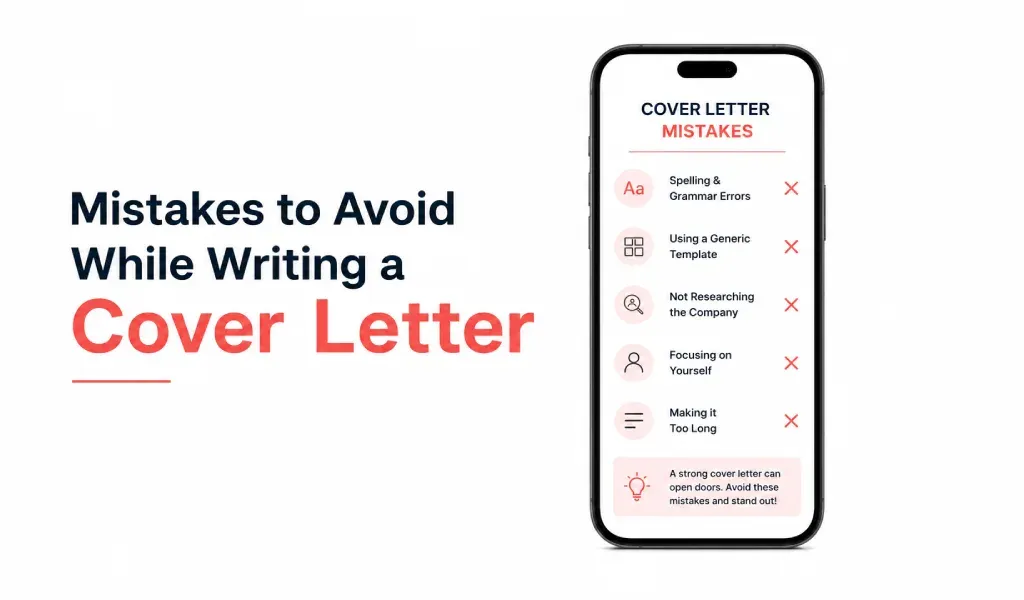
The most common cover letter mistakes are a generic opening, repeating your resume, sending the same letter to every employer, talking only about what you want, and skipping proofreading. Each one is easy to fix once you can see it. Below are ten mistakes, each with a before-and-after line and a fix.
This list is about what to fix. For the writing process, see how to write a cover letter, and for the layout, see the cover letter format guide.
Key Takeaways
- Most mistakes come from being generic: a stock opening, a repeated resume or one letter for every job.
- Show what you can do for the employer, not what you want from the job.
- Back every claim with one specific example.
- Proofread names, dates and the company name, and don't rely on spell check alone.
- Keep the letter to one page and end with a clear next step.
Which Mistakes Hurt a Cover Letter's Opening?
1. A generic opening. Stock lines tell the reader nothing. Southwest Minnesota State University's career office lists openers such as "as my resume shows" among the things to skip. Name the job and give a reason you fit.
- Before: "I am writing to apply for the position you advertised."
- After: "I'm applying for the Customer Support role at [Company]. Three years of resolving [number] tickets a day have prepared me for your team's pace."
2. A generic greeting. The University of Kentucky's Stuckert Career Center warns against greetings like "Dear Sirs," and Southwest Minnesota State lists not naming a recipient as a top mistake. Find a name on the job post, the company's website or LinkedIn.
- Before: "Dear Sir or Madam,"
- After: "Dear Ms. Alvarez," or, if you can't find a name, "Dear Hiring Manager,"
3. Repeating your resume. The letter should add context, not copy bullets. The University of Northwestern - St. Paul's career guide says to avoid repeating your resume word for word.
- Before: "I worked at [Employer] from 2022 to 2024 as a cashier and handled customer service."
- After: "At [Employer] I trained [number] new cashiers on returns, so they could work the register on their own within [time]."
Which Mistakes Weaken the Body?
4. One letter for every employer. The University of Texas at Austin's UT News cites career service experts who advise a tailored letter for each job. Add one detail only this employer would match.
- Before: "I'm excited about the opportunity to join your organization."
- After: "I'm excited about [Company]'s plan to [specific initiative from its website or news]."
5. Talking about what you want. Career centers say to focus on the value you'd bring, not what you'd gain.
- Before: "This role would help me grow my skills and move into management."
- After: "I can take over scheduling for your team, so managers have more time for [priority from the posting]."
6. Vague claims without proof. Traits like "hard-working" are easy to claim and hard to believe. Show one action instead.
- Before: "I'm a hard-working team player with great communication skills."
- After: "I coordinated shifts for [number] coworkers and settled scheduling conflicts before they reached the manager."
7. Too long or too casual. Keep it to one page and three to five short paragraphs, shorter still for email, in a tone that is professional but friendly.
- Before: "Hey! I'm super excited about this job and would be perfect for it!!"
- After: "I'm excited to apply for the [Job Title] role, and I believe my [skill] experience fits it well."
Short on time? Enter the role, company, tone and your key skills in Cover Letter AI & Resume Maker to get a first draft, then rewrite it in your own voice.
Which Mistakes Show Up in the Final Draft?
8. Typos and wrong names. A misspelled name or another company's name left in the text is easy to miss. The Stuckert Career Center says not to rely on spell check alone.
- Before: "Dear Ms. Alvarz, I'm excited to work at [the last company you applied to]."
- After: "Dear Ms. Alvarez, I'm excited to work at [Company]."
9. Apologizing or naming weaknesses. The Stuckert Career Center advises against mentioning weaknesses. Lead with what you have.
- Before: "Although I don't have much experience, I hope you'll give me a chance."
- After: "My two internships taught me [skill], and I'm ready to apply it as a [Job Title]."
10. No clear next step. Southwest Minnesota State's career office lists not asking for an interview as a common mistake, and advises saying when you'll follow up and then doing it.
- Before: "I hope to hear from you soon."
- After: "I'd welcome a conversation about the role. I'll follow up next week."
How Do You Proofread a Cover Letter?
Run through this list before every send.
- Check the recipient's name, company name and job title against the posting.
- Run spell check, then read the letter aloud to catch wrong words.
- Confirm every date, number and claim matches your resume.
- Make sure the first sentence of each paragraph makes a point, since readers may only skim.
- Check that it fits on one page.
- Save it as a PDF unless the employer asks for another format, and open the file once.
A rough AI draft can fall into mistakes 1, 4 and 6 if you don't edit it. Our guide to how to personalize a cover letter shows how to fix that, and our cover letter examples show finished letters.
Related Reading
- How to Write a Cover Letter That Gets Noticed (Step-by-Step): the full step-by-step process.
- Cover Letter Format: Structure, Template and Example: what goes where on the page.
- How to Personalize an AI-Generated Cover Letter (5 Steps): make a draft sound like you.
- 10 Cover Letter Examples for Different Jobs (Copy and Edit): samples that avoid these mistakes.
Sources: Southwest Minnesota State University Career Services, "Cover Letter Do's and Dont's"; University of Kentucky Stuckert Career Center, "General Content for Cover Letter"; UT News, University of Texas at Austin, "Top 5 Cover Letter Don'ts" (May 19, 2016); University of Northwestern - St. Paul, "Cover Letter for Career Changer".
Applying to several jobs? Use Cover Letter AI & Resume Maker for each first draft, then tailor every letter to its job post. Free to download from the App Store for iPhone and iPad, with in-app purchases for some features. AI drafts can contain mistakes, so read and edit every line before you send it.
Frequently Asked Questions
What is the biggest cover letter mistake? Sending a generic letter. Southwest Minnesota State's career office names three common mistakes: not naming a specific recipient, not asking for an interview and not explaining what you can do for the employer. Fix those three first, then work through the rest of the list.
How do I know if my cover letter is too generic? Swap in another company's name. If the letter still works, it's too generic. Add one detail only this employer would match, such as a project, product or value from its website, and one example that only you could write.
Is it a mistake to repeat my resume in my cover letter? Yes, if you repeat it line by line. Southwest Minnesota State's career office says to highlight the parts of your resume that match the job. Use the letter for the story and context behind one or two bullets instead.
Can AI help me avoid cover letter mistakes? AI can give you a first draft, but it doesn't know your facts and can produce generic or inaccurate lines. Check every name, date and claim, then rewrite stock phrases in your own words. You are responsible for what you send, so read the final version carefully.