 Cover Letter AI & Resume Maker
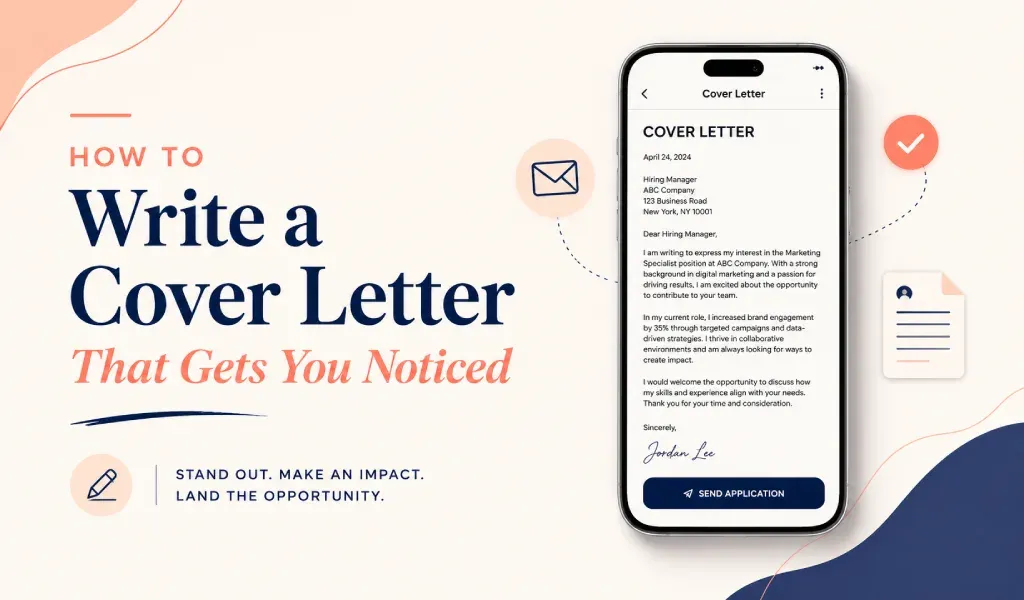
To write a cover letter, read the job post, pick two or three of your strongest matches, open with the role and your best reason to apply, back it up with one specific example, and close by asking for a conversation. Keep it to one page. The six steps below walk through each part.
This guide is the overview, and each part has a deeper guide. For the layout, see the cover letter format guide. For samples, see our cover letter examples or the examples by career stage. To check your draft, see the list of cover letter mistakes. Not sure you need one? See whether recruiters still read cover letters.
Key Takeaways
- A good cover letter names the role, proves one or two strengths with examples and asks for a next step.
- Career centers warn against sending the same letter to every employer, so tailor each one.
- Use the words in the job post to decide what to include.
- Keep it to one page and three to five short paragraphs.
- Proofread names, dates and typos before you send it.
Step 1: Read the Job Post and Pick Your Matches
Spend ten minutes on research before you write. The University of Kentucky's Stuckert Career Center advises researching the company, reading the job description closely and focusing on the value you'd bring rather than what you'd gain.
- Underline the three or four requirements that come first or appear most often.
- Next to each, write the experience, project or result of yours that matches.
- Choose the strongest one or two. These become your body paragraphs.
- Look for the hiring manager's name on the job post, the company's website or LinkedIn.
Step 2: Set Up the Letter
Start with your contact details, the date, the employer's details and a greeting. Southwest Minnesota State University's career office lists not naming a specific recipient among the three most common mistakes, so use a name where you can and "Dear Hiring Manager," where you can't. Our cover letter format guide has a fill-in template and a finished example.
Step 3: How Do You Start a Cover Letter?
Your first paragraph should name the job, say how you found it and give one reason you're qualified, without repeating your resume. That is the Stuckert Career Center's advice. Skip stock openers such as "as my resume shows," which Southwest Minnesota State's career office lists among the things to avoid. Pick an opening and fill it in:
- "I'm applying for the [Job Title] role at [Company]. [Number] years of [skill] at [Employer] have prepared me to [outcome the job needs]."
- "I saw the [Job Title] opening on [site], and my work on [specific project] fits what you describe."
- "[Company]'s [product or project] caught my attention because [specific reason]. I'd like to bring my [skill] to the [Job Title] role."
For complete letters, see our cover letter examples.
Short on time? Enter the role, company, tone and your key skills in Cover Letter AI & Resume Maker to get a first draft, then rewrite it in your own voice.
Step 4: Prove Your Fit With One or Two Examples
The middle of the letter is where you show, not tell. Take one or two matches from Step 1 and describe each in three beats: the situation, what you did and what happened. Tie each to something the employer needs, and use numbers only when you can support them.
If you are changing fields or just starting out, the cover letter examples by career stage show how to frame school projects, part-time work and transferable skills. If you start from an AI draft, treat it as a rough outline and replace anything generic with your own detail. Our guide to how to personalize a cover letter gives a five-step method.
Step 5: How Do You End a Cover Letter?
Close in three short moves: restate your interest in one sentence, ask for a conversation, and thank the reader. Southwest Minnesota State's career office also advises saying when you'll follow up and then doing it, so only promise what you will do. Sign off with "Sincerely," or "Best regards," and your typed name.
- "I'd welcome a conversation about how I can help [Company] with [goal]. Thank you for your time."
- "I'll follow up next week to see whether a short call would be useful."
Step 6: Edit, Proofread and Send
Edit for length first. The University of Wisconsin-Green Bay recommends one page, and the Stuckert Career Center suggests three to five short paragraphs. Then proofread:
- Read it aloud and cut anything you wouldn't say.
- Check the company name, job title and recipient's name against the posting.
- Don't rely on spell check alone, as the Stuckert Career Center warns.
- Confirm that every claim matches your resume.
- Save it as a PDF unless the posting asks for another format, and give the file a clear name.
Then compare the draft with our list of cover letter mistakes.
What Does a Finished Cover Letter Look Like?
This sample is fictional.
Dear Ms. Alvarez,
I'm applying for the Marketing Coordinator role I found on Cedar & Pine Market's careers page. For two years I've managed the email newsletter and social channels at a regional bookstore, and I enjoy turning a small budget into steady engagement.
Last spring I redesigned our monthly newsletter around one featured book and added a reader question to each issue. The format worked well enough that we kept it. I also write the copy, schedule the posts and report results to the owner each month.
I've followed your reading-list campaign and have two ideas for extending it. I'd welcome the chance to share them in an interview. Thank you for your time.
Sincerely,
Jordan Lee
The opening names the job and a reason to hire, the middle gives one concrete example, and the last paragraph asks for a conversation.
What If the Application Asks for a Motivation Letter?
Some universities, scholarship programs and employers ask for a motivation letter instead. It covers similar ground but puts more weight on why you want this program or role. Our guide to motivation letter vs cover letter explains the differences.
Related Reading
- Cover Letter Format: Structure, Template and Example: what goes where on the page, with a template.
- 10 Cover Letter Examples for Different Jobs (Copy and Edit): ten sample letters for different jobs.
- 10 Cover Letter Mistakes to Avoid (and How to Fix Them): ten errors to fix before you send.
- How to Personalize an AI-Generated Cover Letter (5 Steps): make an AI draft sound like you.
Sources: University of Kentucky Stuckert Career Center, "General Content for Cover Letter"; Southwest Minnesota State University Career Services, "Cover Letter Do's and Dont's"; University of Wisconsin-Green Bay Career Planning & Professional Connections, "Writing Professional Cover Letters".
Applying to several jobs? Use Cover Letter AI & Resume Maker for each first draft, then tailor every letter to its job post. Free to download from the App Store for iPhone and iPad, with in-app purchases for some features. AI drafts can contain mistakes, so read and edit every line before you send it.
Frequently Asked Questions
How do I start a cover letter? Name the job and give one specific reason you fit, such as your years of experience or a relevant result. Skip stock openings like "as my resume shows." If you can find the hiring manager's name, use it in the greeting.
How long should a cover letter be? One page and three to five short paragraphs, according to career centers such as the University of Wisconsin-Green Bay and the University of Kentucky. Emailed letters can be shorter still. If the employer sets a length or character limit, follow it.
Should I address the hiring manager by name? Yes, if you can find the name on the job post, the company's website or LinkedIn. Southwest Minnesota State's career office lists not naming a specific recipient as a common mistake. If you can't find a name, "Dear Hiring Manager," is acceptable.
Do I need a cover letter if the job doesn't require one? Not always, but an optional letter can help when you have something to say that your resume doesn't, such as why you're changing careers. See whether recruiters still read cover letters to decide. If you do write one, keep it short and tailored.
How do you end a cover letter? Restate your interest in one sentence, ask for a conversation and thank the reader. Say when you'll follow up only if you will. Sign off with "Sincerely," or "Best regards," followed by your typed name.