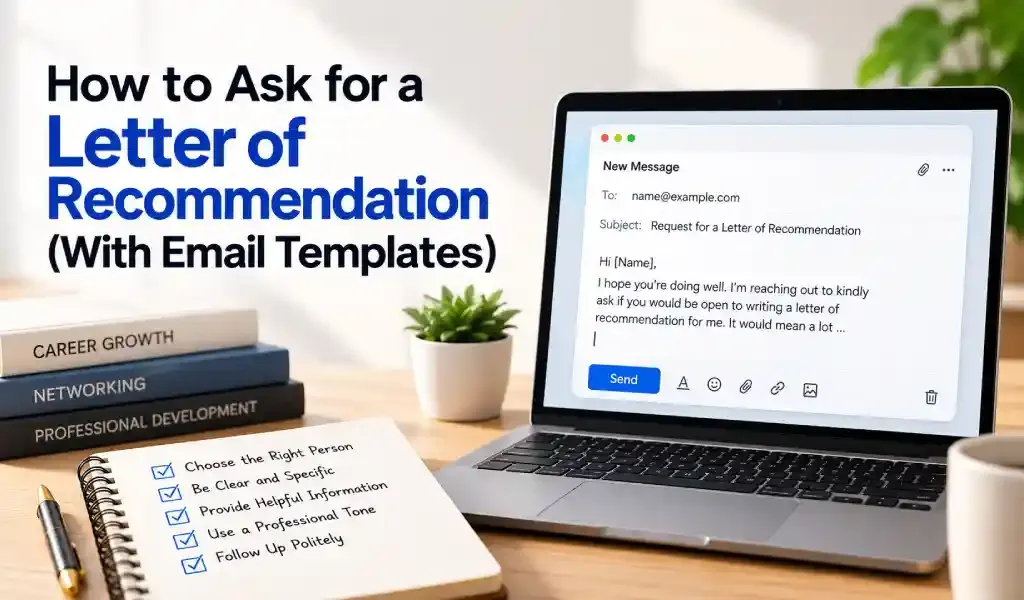
A weak ask gets a weak letter. A rushed ask can get you no letter at all.
Ask four to six weeks before your earliest deadline. Choose someone who knows your work in detail. Phrase the question so they can say no. Then send your resume, your deadlines, and the points you want covered. Check in two weeks before the due date, and thank them afterward.
Below are the steps, plus four email templates you can copy.
Key Takeaways
- Most career centers recommend asking four to six weeks ahead. Two weeks is the bare minimum.
- The best writer is the person who can give specific examples, not the most impressive title.
- Always ask "Can you write a strong letter?" instead of "Will you write a letter?"
- Send a packet: resume, deadlines, submission details, and three to five points to highlight.
- In the US, a FERPA waiver is usually part of academic requests.
Who Should You Ask?
Pick the person who can describe your work with real detail.
Penn Career Services advises choosing someone who can speak to the skills your target program needs. That is not always the person you like most. It also notes that character references from family friends are generally not helpful.
Check what the application asks for first. Some programs want academic recommenders. Others prefer professional ones. A few accept a mix.
When Should You Ask?
Earlier is better. Recommenders are busy, and good letters take time to draft and revise.
| Situation | Suggested lead time |
|---|---|
| Ideal | 4 to 6 weeks before the earliest deadline |
| Workable | 3 to 4 weeks |
| Repeat request to the same person | At least 2 weeks |
| Absolute minimum | 2 weeks, and expect a tough yes |
Several schools give the same range. Union College's career center says at least five to six weeks. Johns Hopkins suggests three to four.
Use your earliest deadline as the target. Occidental College points out that internal deadlines count too, not just the final one.
How to Ask So They Can Say No Gracefully
Ask in person or by a short email first. Do not use the application portal to "request" a letter before they have agreed.
Then phrase the question carefully. Connecticut College's career office suggests: "Do you feel you know me well enough to write a strong letter of recommendation for this program?" That gives the writer an easy way out.
If you sense hesitation, thank them and ask someone else. A lukewarm letter does more harm than a different recommender.
What to Send Once They Say Yes
Make their job easy. Send one organized email with:
- Your current resume. Our guide to the most important resume sections helps you keep it tight.
- The role or program description. A link is enough.
- Your statement or draft. If you're applying to graduate school, our SOP guide can help.
- A transcript, if the application is academic.
- Every deadline and the submission method. Say whether the letter goes by email, portal, or post.
- Three to five points to highlight. JHU's guide recommends this, so the writer doesn't have to guess.
Should You Waive Your FERPA Rights?
In the US, academic applications often ask whether you waive your right to read the letter.
Waiving means you give up that right. St. Olaf College says it is almost always best to waive, so the reader knows the letter was written in confidence. Some writers will not write a non-confidential letter at all.
The rule comes from a US law. You can read the basics on the US Department of Education's FERPA page. Most employer references do not involve it.
4 Email Templates You Can Copy
1. The Ask
Subject: Request for a recommendation, [Your Name]
Dear [Name],
I'm applying to [program or role] at [organization], and your [class or project] was a big part of why. Do you feel you know my work well enough to write a strong letter of recommendation for me?
The earliest deadline is [date]. If you're not able to, I completely understand.
Thank you for considering it.
[Your Name]
2. After They Say Yes
Subject: Materials for my recommendation letter
Dear [Name],
Thank you for agreeing to write this. I've attached my resume, the program description, and my draft statement.
My earliest deadline is [date]. The letter goes to [email or portal link]. If it helps, I'd love for the letter to mention [point 1], [point 2], and [point 3].
I'm happy to meet for ten minutes if you'd like more context.
[Your Name]
3. The Gentle Reminder
Send this about two weeks before the due date if the letter isn't in yet.
Subject: Quick check-in on my recommendation
Dear [Name],
I wanted to check in on the letter due [date]. Is there anything else I can send you? I know it's a busy time.
Thank you again.
[Your Name]
Programs sometimes send the request to a spam folder. A reminder catches that too.
4. The Thank-You
Subject: Thank you
Dear [Name],
Thank you for writing my letter. It meant a lot, and I'll let you know how the application goes.
[Your Name]
Keep your promise to share the result. It keeps the relationship warm for next time.
Mistakes That Weaken the Letter
- Asking too late. Rushed letters tend to be short and generic.
- Sending a vague request. "I need a letter" tells them nothing.
- Skipping the packet. Without details, even a fond writer falls back on clichés.
- Requesting letters for places you won't apply to. Each letter is extra work.
- Forgetting to say thanks.
Where an App Can Help
You'll need a current resume before you send anything. Building one from scratch while a deadline looms is stressful.
Cover Letter AI & Resume Maker can generate an ATS-friendly resume from your details, and it lists recommendation drafting under its formal documents. If a busy recommender asks for talking points, you can use it to organize your achievements. The writer must review, rewrite in their own voice, and sign only what is true.
The app is iOS only. The person writing for you owns the letter.
Applying for an internship or a motivation-based program next? Our guides to writing an internship application letter and writing a letter of motivation pair well with a strong recommendation.
Frequently Asked Questions
How far in advance should I ask for a letter of recommendation? Four to six weeks before your earliest deadline is the common advice. Two weeks is the minimum, and many people will decline at that point.
Can I ask for a recommendation by email? Yes. Email is generally acceptable. Asking in person first is a nice touch if you can.
What if my recommender seems hesitant? Take it seriously. Thank them and ask someone else. A strong letter needs an enthusiastic writer.
Should I waive my right to see the letter? For US academic applications, career centers usually advise yes. It signals the letter is candid. Read the form before signing.
Do I need to thank my recommender? Yes. A short email works. Then tell them how things turned out.