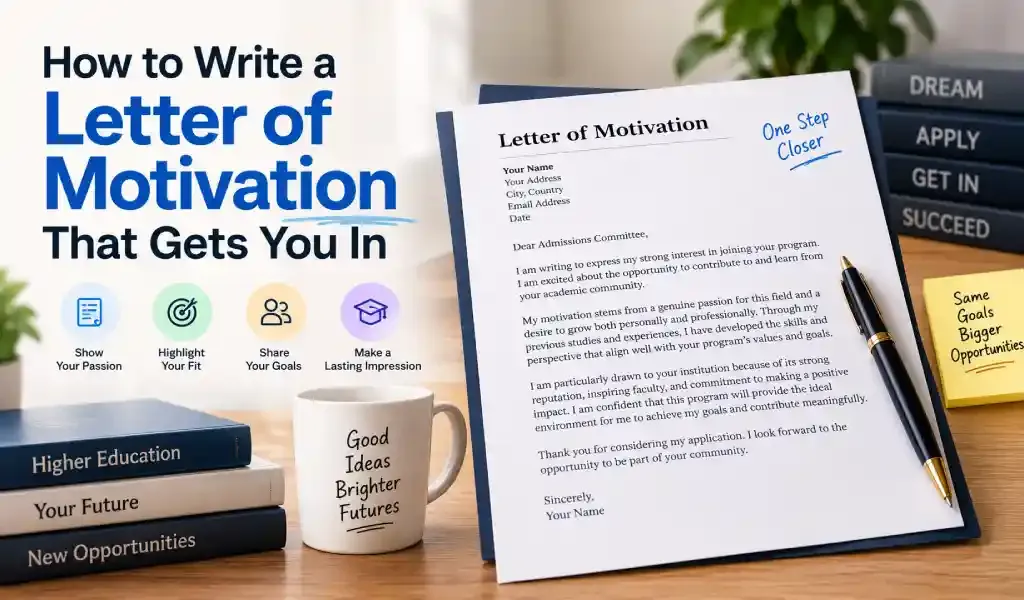
A motivation letter is not a cover letter with a different name. It does a different job.
Quick answer: A motivation letter explains why you want a specific opportunity, not what you've achieved. It's used for university programs, scholarships, internships, and volunteer roles, and runs 300 to 500 words on one page. The strongest ones name the exact program or organization and connect it to a real personal reason, not a generic ambition.
Here's how to write one that actually stands out.
Key Takeaways
- A motivation letter focuses on personal reasons and goals, not job skills.
- Europe commonly calls this document a "motivation letter." The US and UK often call the same idea an SOP or personal statement.
- Most run 300 to 500 words. Always check the program's stated limit first.
- The single biggest mistake is writing something generic enough to send anywhere.
- Structure matters more than polish: a clear opening, specific reasons, and a confident close.
What Is a Letter of Motivation?
A motivation letter explains your personal reasons for pursuing something. Not your resume. Your reasons.
It's most common for university applications, scholarships, internships, and volunteer or non-profit roles. Career guidance from Resume.co notes a clear regional pattern too: Europe frequently requires a "motivation letter," while North America and Australia lean toward "cover letter" for job applications.
The content overlaps. The angle doesn't. A cover letter proves you can do the job. A motivation letter proves you actually want it, and why.
Motivation Letter vs. Cover Letter vs. SOP
These three get confused constantly, so here's the short version.
- Cover letter: for paid jobs. Focuses on skills, experience, and fit for the role. See our guide on writing a cover letter that gets you noticed.
- Motivation letter: for programs, scholarships, or volunteer roles. Focuses on personal motivation and alignment with the organization's mission.
- Statement of Purpose (SOP): mainly academic. Often longer, with more room for your full academic story. US and UK universities tend to call this an SOP, while the same document is called a motivation letter across much of continental Europe. We cover this in more depth in our SOP writing guide.
If a program asks for a "motivation letter" specifically, keep it tighter and more direct than an SOP. One comparison puts it simply: an SOP tells a fuller story, a motivation letter focuses on why this opportunity, right now.
How Long Should It Be?
Short. Shorter than you think.
Most motivation letters run 300 to 500 words, fitting on a single page. University-specific letters sometimes stretch to 700 or 800 words, but only when the program allows it. If the application states a word or page limit, follow it exactly. Going over signals you didn't read the instructions.
The Structure That Works
Four parts, in this order.
- Opening hook. Skip "I am writing to apply for..." Open with the specific moment or reason that led you here. One sentence is enough.
- Relevant background. One paragraph connecting your actual experience, coursework, or work, to this specific opportunity.
- Why this program or organization. Name something real: a specific course, faculty member, mission statement, or project. This is the paragraph that separates a real letter from a template.
- Confident close. Restate your motivation in one line. Thank the reader. End without over-explaining.
Here's the difference in practice. A generic close reads: "I am eager to contribute my skills to your team." A specific one reads: "Your team's focus on accessible design is exactly the kind of work I want to spend the next two years learning."
The second version could only go to one place. That's the point.
Common Mistakes to Avoid
- Writing something that could apply anywhere. This is the top reason letters get rejected. Name the program. Name the organization. Be specific.
- Being negative about a past school, job, or employer. Reframe it as growth instead.
- Overdoing the flattery. Genuine interest reads differently than empty praise.
- Addressing the wrong person or the wrong program name. A copy-paste error here is an instant red flag.
- Skipping the proofread. Grammar mistakes undercut a document that's supposed to show care.
Where AI Actually Helps Here
A motivation letter lives or dies on specifics: the program name, the mission, your real reason for applying. A blank AI prompt can't invent those. You still have to provide them.
What a tool can help with is structure and speed, especially when you're writing several of these for different programs or scholarships in the same season. Cover Letter AI & Resume Maker includes motivation letters alongside cover letters, resumes, and other formal documents like freelance proposals, so the formatting and structure are handled while you focus on the one part that actually has to come from you: the reason.
Frequently Asked Questions
Is a motivation letter the same as a cover letter? No. A cover letter focuses on job skills and experience. A motivation letter focuses on personal reasons for pursuing a program, scholarship, or opportunity.
How long should a motivation letter be? Usually 300 to 500 words on one page. Some university applications allow up to 700 to 800 words. Always check the program's specific limit.
What's the difference between a motivation letter and an SOP? Mostly terminology and length. European institutions often say "motivation letter." US and UK institutions often say "SOP" or "personal statement." SOPs typically allow more room for your full academic story.
Do jobs ever ask for a motivation letter instead of a cover letter? Yes, particularly for roles at non-profits, NGOs, and some European employers. When in doubt, follow the exact term used in the application.
What's the biggest mistake in a motivation letter? Writing something generic enough to send to any program. The strongest letters name the specific institution, course, or mission, and explain why it matters to you.