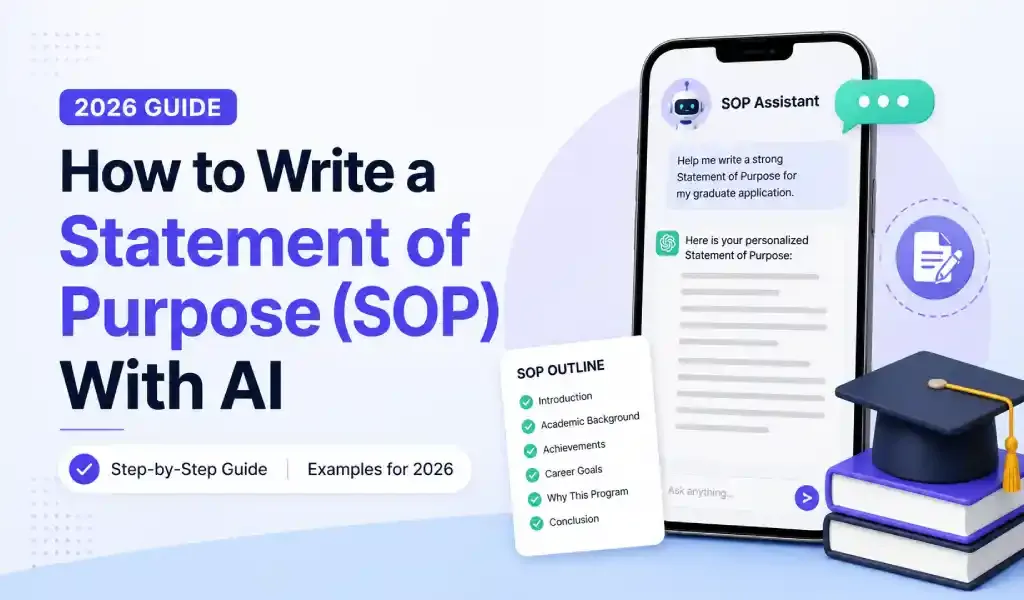
A statement of purpose is not a cover letter. Treat it like one, and admissions committees notice fast.
Quick answer: AI can speed up your SOP. It can organize your background into a clear structure and tighten weak sentences. What it can't do is supply the specific details, named professors, real research questions, personal turning points, that make a statement of purpose convincing. Use AI to build the skeleton. Write the specifics yourself.
Here's how to do that well, with examples.
Key Takeaways
- A standard SOP runs 800-1000 words across 5-8 paragraphs, though length varies by program.
- In one blind study, admissions readers could only tell AI-written from human-written statements 56% of the time, barely better than a coin flip.
- AI-detection tools scored higher (91% in the same study) but flagged real human writing too often to be trusted alone.
- Most admissions offices still rely on human judgment over detection software (NACAC).
- Naming a specific professor, paper, or lab is one of the strongest signals of genuine program fit.
What Makes an SOP Different From a Cover Letter
A cover letter sells your work experience for a job. An SOP sells your research fit for a program.
Good SOPs answer three questions, a framework outlined by College Essay Guy's admissions coaches: what you've done, why this field and program, and how you'll use the program's specific resources.
The "how" is where most drafts fall apart. Naming a real professor whose research aligns with yours signals you've gone past the department homepage. Generic praise for "your esteemed program" signals the opposite.
If you're job hunting rather than applying to a program, the rules shift. See our winning cover letter examples for how that document works instead.
The Structure That Actually Works
Most strong SOPs follow a similar shape, even though prompts vary by program.
Standard formatting guidance puts length around 800-1000 words, roughly one to two pages, across 5 to 8 paragraphs:
- A specific opening moment, not a mission statement.
- Academic background relevant to the field.
- Research or work experience that built your skills.
- Why this program, named faculty, labs, or courses included.
- Career or research goals after graduation.
Engineering, medical, and research-fellowship SOPs share this shape but differ in emphasis. Engineering SOPs lean on projects and technical depth. Medical school statements lean on clinical exposure and motivation. Research fellowship SOPs lean hardest on a specific research question and methodology fit.
Can Admissions Committees Tell an SOP Was Written by AI?
Less reliably than most applicants assume.
A randomized study published in the Journal of the American College of Surgeons tested this directly. Seventeen medical school admissions readers scored 309 real and AI-generated personal statements in a blind trial. Readers correctly identified authorship only 56% of the time. A dedicated AI detector, ZeroGPT, scored 91%, but its false-positive rate ran high enough that researchers called it unreliable for admissions use on its own. AI-written statements in the study were also rated slightly higher on average.
That result surprises people. But detection software struggles for a consistent reason: imperfect detectors flag real human writing too often to trust alone. A 2024 NACAC survey found only a small share of admissions offices plan to adopt AI-detection tools, with most preferring trained human readers instead.
Some systems are the exception. The UK's UCAS has invested heavily in detection, and flagged personal statements have climbed sharply since 2023. Rules genuinely vary by country and institution, so check your specific program's policy before assuming either way.
Why Generic Still Loses, Even When It "Passes"
Here's the part the detection debate misses. Passing as human isn't the goal. Getting admitted is.
Admissions readers spend years reading statements. They develop instinct for one specific pattern: technically fine writing that could belong to any applicant, in any program. A statement built entirely from a single AI prompt tends to read exactly like that. Smooth, competent, and interchangeable.
The fix isn't hiding AI use. It's adding what AI cannot invent: a real professor's name, a real paper you've actually read, a real moment that explains your interest. These specifics are also where AI is most likely to hallucinate, so never let a model invent a citation, a lab name, or an achievement on your behalf.
How to Use AI on Your SOP the Right Way
- Brainstorm with your real material. Feed AI your actual background, not a vague prompt. Garbage in, generic out.
- Use AI for structure, not substance. Let it organize scattered notes into a WHAT-WHY-HOW shape.
- Add the specifics yourself. Named professors, papers, and moments belong to you, not the model.
- Rewrite one draft per program. A shared SOP reads as generic to every reader who sees it.
- Read it aloud. If a line doesn't sound like you, it probably came straight from the prompt.
We cover this same personalization habit for job applications in how to personalize AI-generated cover letters. The principle carries over directly: AI drafts the shape, you supply what makes it yours.
A purpose-built tool also helps more than a blank chat window here. A general prompt doesn't know whether you're applying to an engineering program or a medical school, so it defaults to one generic shape either way. The SOP tools inside Cover Letter AI & Resume Maker start from the field you're applying to, engineering, medical, or research fellowship, so the first draft is already shaped correctly. You still add the professor's name and the real story yourself. The app just saves you from rebuilding structure from scratch each time.
Quick Examples by Field
- Engineering: "Our capstone robot's grip failed under load. That failure sent me into six months of research on soft actuators, and straight into Professor [Name]'s recent work on adaptive grip control."
- Medical school: "I watched a resident sit in silence before telling a family bad news. That pause taught me more about medicine than any textbook had."
- Research fellowship: "My thesis found a gap nobody had addressed: heat maps that miss low-income neighborhoods entirely. Dr. [Name]'s equity-weighted climate model is the first approach I've seen that could close it."
Each opener names something specific. None of them could be swapped into a different applicant's essay, which is exactly the test your finished SOP should pass too.
Frequently Asked Questions
Can I use ChatGPT to write my statement of purpose? Yes, for structure and brainstorming. Admissions committees increasingly notice generic AI writing, so the specific, personal details still need to come from you.
Can admissions committees detect an AI-written SOP? Not reliably. One study found human readers were only 56% accurate, barely better than guessing. Detection software scores higher but flags real human writing too often to be trusted alone.
How long should a statement of purpose be? Most run 800-1000 words across 5-8 paragraphs, roughly one to two pages. Always follow your specific program's stated limit first.
What's the difference between a personal statement and a statement of purpose? A statement of purpose focuses on research goals and program fit. A personal statement is often broader, covering background and motivation. Some programs use the terms interchangeably, so read the actual prompt.
Does naming a professor in my SOP really matter? Yes. It's one of the clearest signals that you've researched the program specifically, rather than sending the same statement everywhere.