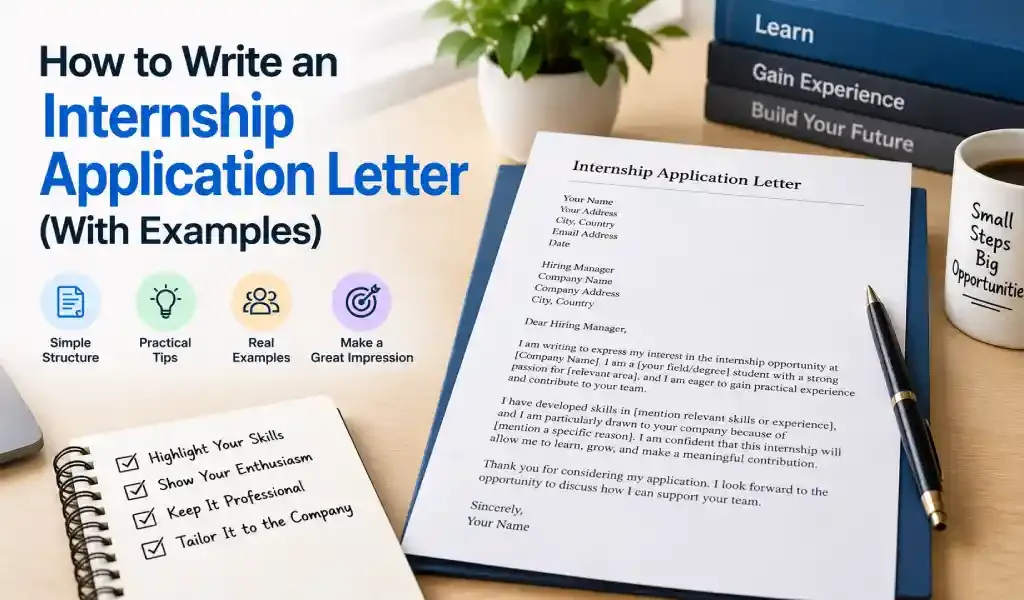
Internships are converting to real jobs at the highest rate in five years. NACE's 2026 Internship & Co-op Report puts the conversion rate at 63.1%, up sharply from the year before. Your application letter is the first hurdle to get there.
An internship application letter needs five things: a real name in the greeting, a specific reason you want this internship, coursework or projects mapped to the role, one detail showing you researched the company, and a confident close. Skip any of these and it reads like the hundred other letters in the pile.
Here's how to build one, with a full example below.
Key Takeaways
- Internship letters lean on coursework and projects, not job history. That's normal.
- Generic, mass-sent letters are the single biggest reason employers say no.
- One specific detail about the company beats three vague compliments.
- Keep it under 300 words. Hiring coordinators skim.
- Structure matters more than eloquence. Follow the formula below.
How Is an Internship Letter Different From a Regular Cover Letter?
A regular cover letter usually leans on work history. An internship letter can't, because most applicants don't have much yet.
That's fine. Employers hiring interns already expect this. What they're actually screening for is potential: relevant coursework, class projects, part-time jobs, campus leadership, anything that shows initiative and transferable skill. The format stays the same. The evidence just comes from a different place.
The 5-Part Structure That Works
Career centers at schools like Duke, Michigan, and Iowa all land on the same basic shape. Here's the version that holds up:
- Address a real name. University of Michigan's career center puts it plainly: find the hiring manager's name if you can, or at least use a title like "Internship Coordinator." Skip "To Whom It May Concern" entirely.
- Open with a specific reason. Name the internship, and say what about it caught your attention. Generic enthusiasm reads as generic.
- Connect coursework or projects to the role. Pick one or two concrete examples. A class project, a part-time job, a club you ran. Include a real result if you have one.
- Show you researched the company. One sentence referencing something specific, a product, a recent initiative, a case study, does more than three sentences of general praise.
- Close with confidence. Restate your interest, invite next steps, thank them. No apologizing for lack of experience.
Handshake's internship cover letter guide echoes the same point that shows up across nearly every career center resource: never reuse the same letter for every application. Employers notice.
Example: Full Internship Application Letter
Here's what that structure looks like in practice. This one's written for a marketing internship, but the shape works for any field, swap the specifics for your own.
Dear Ms. Alvarez,
I saw Brightpath Media's summer marketing internship posted through my university's career center, and the focus on social campaigns for small businesses caught my attention right away. I've spent the last two semesters running ad tests for our school paper's Instagram account, and I'd like to bring that same hands-on approach to your team.
At State University, I'm a junior majoring in Marketing with a minor in Data Analytics. Last spring, my Digital Marketing course assigned a semester-long project building a real ad campaign for a local coffee shop. My team's Instagram strategy grew their follower count by 40% and drove a measurable bump in weekend foot traffic, tracked through a UTM link the owner let us set up. I also work 12 hours a week at the campus bookstore, where I redesigned our email newsletter layout, a change that doubled our open rate in one semester.
I'm drawn to Brightpath specifically because of the bakery case study on your website. The before-and-after engagement numbers you shared are exactly the kind of result I want to learn how to produce myself.
I'd welcome the chance to talk about how I could contribute this summer. Thank you for your time and consideration.
Sincerely, [Your Name]
Notice what's doing the work: real numbers, one named company detail, no filler adjectives.
3 Mistakes That Sink Internship Letters
- Sending the same letter everywhere. Swap a company name into a template and the rest still reads generic. Career advisors flag this as the top reason employers reject applicants outright.
- Repeating the resume. The letter should add context your resume can't, not restate bullet points in sentence form.
- Ending without a clear close. "Thank you for your consideration" alone is weak. Say you'd welcome a conversation, then thank them.
Making This Faster for Multiple Applications
The structure above works. The hard part is doing it ten or twenty times for different companies without every letter blurring into the last one.
If you're also starting your resume from scratch, our guide on writing a resume with no experience covers the same coursework-and-projects approach used here. Once you have a draft letter, whether you write it yourself or generate a starting point, the personalization steps in how to personalize an AI-generated cover letter apply directly: swap in the job description, name a real detail about the company, add your own achievement.
An app like Cover Letter AI & Resume Maker can build that first draft from your resume and the internship posting, so applying to your fifth company doesn't mean starting from a blank page again. You still add the specific detail and the real result. That part has to be yours.
Frequently Asked Questions
Do I need a cover letter for an internship application? Yes, even when it's marked optional. It's often the only place you can explain why you want this specific internship, not just any internship.
How long should an internship cover letter be? Around 250 to 300 words, or three to four short paragraphs. Hiring coordinators read dozens of these quickly.
What if I have no relevant experience at all? Use coursework, class projects, part-time jobs, or campus organizations. Employers hiring interns expect potential, not a resume full of prior internships.
Should I address it to a specific person? Whenever possible. If you can't find a name, use a title like "Hiring Manager" or "Internship Coordinator" instead of a generic greeting.
Sources: NACE 2026 Internship & Co-op Report, Handshake, University of Michigan Career Center.