 Cover Letter AI & Resume Maker
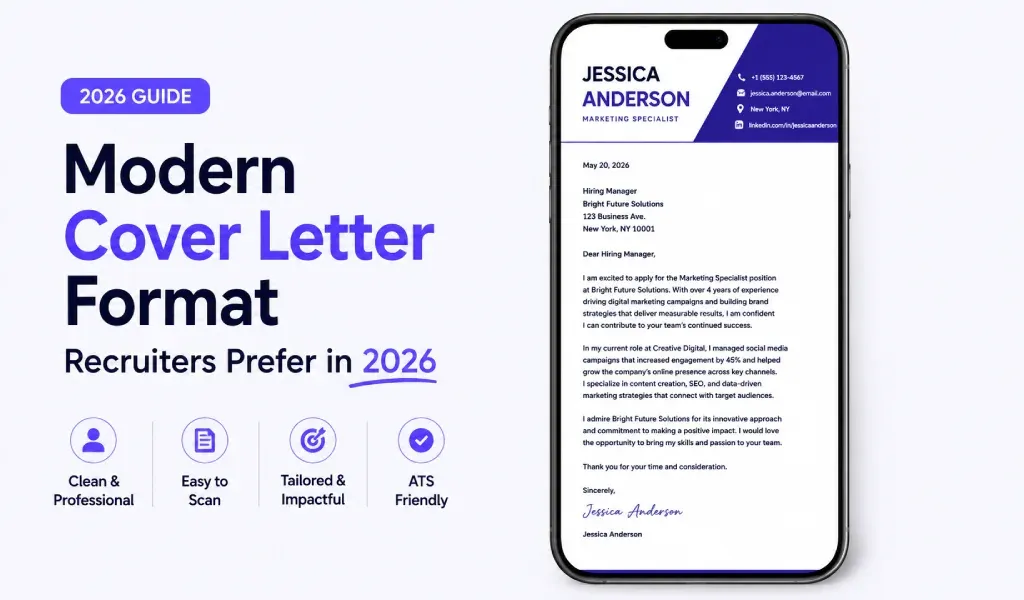
A modern cover letter keeps the same job as the standard one but gets to the point faster. Aim for 200 to 300 words, lead with your strongest fit, and match the format to how you're applying: a short letter, an email, or text pasted into an application form. Formal fields may still expect the classic layout.
This guide covers the shorter formats. For the classic layout, see our guide to the standard cover letter format. For fonts and margins, see cover letter font and margins.
Key Takeaways
- "Modern" means shorter and easier to scan, not careless.
- Use a short letter for a quick introduction, an email body when you're writing to a person, and plain text for portal boxes.
- Skip formatting that won't survive a paste, such as columns, tables and special characters.
- Formal fields such as law or government may still expect the classic layout.
- In every format, tailor the first two sentences to the job.
When Should You Use a Modern Cover Letter?
Choose the format that matches how you're applying. If the posting names a format or a length, that always wins.
| Situation | Best format | Why |
|---|---|---|
| The application has a text box | Portal version | Forms often strip formatting and cap length |
| You're emailing a named person | Email version | A short note is easier to read than a full letter |
| The workplace is informal, or the posting asks for a quick intro | Short version | Gets to your fit in a few lines |
| The posting lists clear requirements | T-format | Lines your experience up against theirs |
| The industry is formal, or the posting asks for a traditional letter | Standard layout | Matches what the reader expects |
Version 1: The Short Cover Letter
This version runs about 100 words once you fill it in. Add a second example if you have room.
Dear [Name],
I'm applying for the [job title] role at [Company]. For [number] years I've [one-line summary of your most relevant experience], and your posting's focus on [priority from the post] is where I do my best work.
At [Previous employer], I [specific action] that led to [result]. I also [second strength, with a short example].
I'd welcome a conversation about how I can help [Company] with [goal]. My resume is attached.
Thank you for your time,
[Your Name]
Version 2: The Email Cover Letter
Put the job title and your full name in the subject line. The Office of Career Development at Northeastern Illinois University (NEIU) recommends this, and says to follow the posting if it specifies a subject-line format. Some examples:
- Application for [Job Title], [Your Name]
- [Job Title] application, [Job ID if listed]: [Your Name]
Career centers disagree on one point. NEIU advises attaching the cover letter and keeping the email brief. Rotman Commerce at the University of Toronto suggests putting the letter in the email itself. If the posting doesn't say, write a short pitch in the email and attach your letter and resume as PDFs.
Subject: Application for [Job Title], [Your Name]
Dear [Name],
I'm applying for the [Job Title] position. I bring [one line on your strongest fit], and I've attached my resume and cover letter for your review.
[One sentence with your best example for this role.]
Thank you for considering my application. I'd be glad to talk whenever it suits you.
Best regards,
[Your Name], [Phone], [Email]
Don't want to set up the layout by hand? Cover Letter AI & Resume Maker offers resume templates and fonts, and drafts cover letters from your inputs.
Version 3: The Text-Box Version for Online Applications
Portals often strip formatting or cut off long text. Follow these rules and your letter will paste cleanly:
- Write it in a plain-text editor first, not a word processor.
- Skip bullets, tables, columns and special characters.
- Separate paragraphs with a blank line.
- Check the character limit before you paste, and trim to fit.
- Read the preview after pasting, and keep a saved copy of what you submitted.
Hello [Hiring Team],
I'm excited to apply for [Job Title]. [One sentence summarizing your fit.] In my last role at [Company], I [achievement with result].
I'd bring the same focus to [Company]'s work on [specific project or goal]. Thank you for your time.
[Your Name]
What Is a T-Format Cover Letter?
A T-format letter sets the employer's requirements next to your matching experience in two columns. It works when the posting lists clear requirements, and it makes your fit easy to scan. Here is the idea:
| What you're looking for | What I bring |
|---|---|
| Experience with scheduling software | Three years managing a six-provider calendar in [tool] |
| Clear written communication | Wrote the patient reminder emails our clinic still uses |
| Comfort with phone support | About 40 calls a day at my current front desk |
Tables can break when pasted into forms, so send a T-format letter as an attachment or in an email, and keep a plain-text version in case a portal needs it.
How Do You Keep a Short Letter Personal?
Short doesn't have to mean generic. Name the company and the role in the first sentence, and tie one example to something in the posting. If you start from an AI draft, our guide to how to personalize a cover letter shows how to make it yours.
Not sure a letter is worth writing for this application? See whether recruiters still read cover letters.
Related Reading
- Cover Letter Format: Structure, Template and Example: the classic layout, block by block.
- Cover Letter Font, Margins and Length: Formatting Guide: font, margins and file settings.
- Do Recruiters Still Read Cover Letters? When It Matters: when a cover letter is worth writing.
- How to Personalize an AI-Generated Cover Letter (5 Steps): make a draft sound like you.
Sources: Northeastern Illinois University Office of Career Development, "How To Email Your Resume and Cover Letter to Employers"; Rotman Commerce Career Services, University of Toronto, "How to Format an Email".
Once your structure is settled, Cover Letter AI & Resume Maker can generate the draft and export it as a PDF or Word file for you to finish. Free to download from the App Store for iPhone and iPad, with in-app purchases for some features. AI drafts can contain mistakes, so read and edit every line before you send it.
Frequently Asked Questions
How long should a modern cover letter be? Aim for roughly 200 to 300 words, or a few short paragraphs. That's our rule of thumb, not a universal standard. If the employer names a length or character limit, follow it. Shorter is fine when every sentence earns its place.
What is a T-format cover letter? It's a two-column layout with the employer's requirements on the left and your matching experience on the right. It suits roles with clear requirement lists. Skip it for formal industries, and keep a plain-text version for portals.
How do I format a cover letter in an email? Put the job title and your full name in the subject line, address the recruiter by name, keep the body brief, and sign with your phone and email. Attach your resume and letter as PDFs unless the posting asks for something else.
Should I attach the cover letter or paste it into the email? Career centers disagree. Some say to attach it and keep the email short, others say to paste it into the body. If the posting doesn't say, write a brief pitch in the email and attach the full letter as a PDF.
Are cover letters still necessary? Not always. Some postings require one, some make it optional, and some portals have no place for it. If it's optional and you have a real reason to write, a short one can help. We cover the decision in whether recruiters still read cover letters.