 Cover Letter AI & Resume Maker
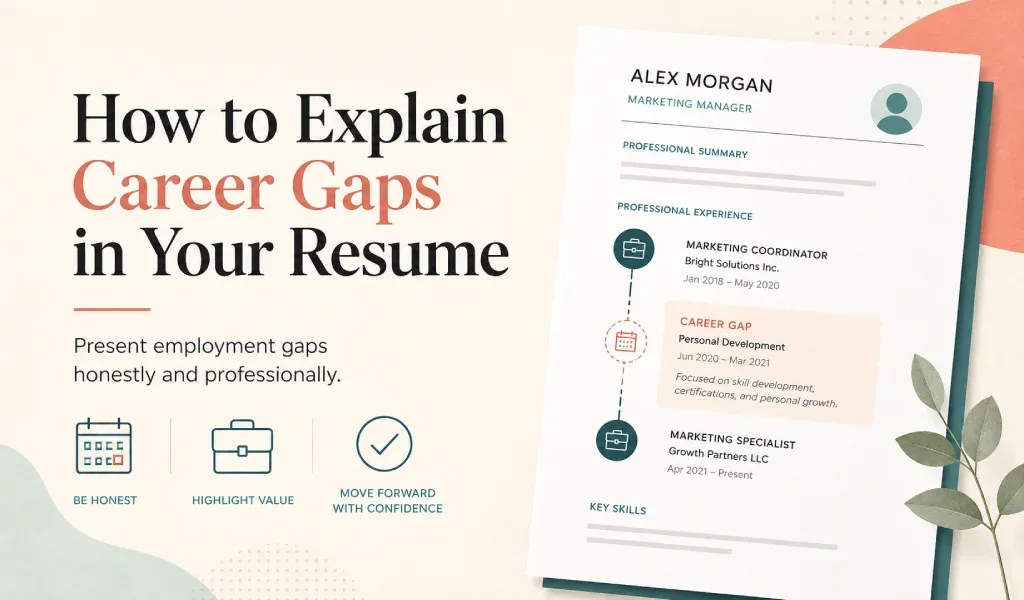
To explain a career gap on a resume, be brief and honest: use year-only dates for short gaps, add a one-line entry for longer ones, and show what you did or kept current during the time. Then address it in your cover letter and interview with a short, prepared answer. Example wording for each cause is below.
The example wording is ours, based on guidance from UNLV, the University of Arizona and Oregon State University. Adapt it to your situation and keep it truthful.
Key Takeaways
- A gap is common and is not a dealbreaker if you address it directly, according to UNLV Career Services.
- Short gaps may need only year-only dates. The University of Arizona says gaps of more than a year should be explained in the experience section.
- Show what you did or kept current: volunteering, courses, freelance work or caregiving tasks that match the job.
- Never change dates or stay vague about the gap.
- Prepare a short interview answer: the reason, what you did, and why you are ready now.
Do You Have to Explain a Career Gap on Your Resume?
Not always. The University of Arizona's career center says an early-career gap that is short relative to your experience may not need to appear, and that gaps of more than a year should be explained in the experience section. Oregon State's guide says you do not have to raise a gap yourself, but you can address it in a cover letter or interview if it helps.
UNLV Career Services, adapting a DePaul University guide, says hiring managers mainly want to know about your current skills, job readiness and commitment. Treat the gap as part of your story, and focus on what you learned and how you stayed current.
What Are Your Resume Layout Options?
| Option | How it works | Best when |
|---|---|---|
| Year-only dates | Write 2022 to 2024 instead of months | The gap is a few months. Arizona and Oregon State both mention it |
| A short gap entry | One line in Experience, such as "Full-time caregiver, 2022 to 2024," with one or two bullets of relevant skills | The gap is over a year, or you built skills during it |
| Hybrid format | A short summary of skills and strengths first, then a traditional experience section | You have strong skills to lead with (UNLV) |
| Functional format | Skill-based sections that can hold jobs, volunteer work and projects | Your history is uneven (UNLV, Arizona, Oregon State) |
| Relevant activity | Courses, certificates, volunteering or contract work during the gap | You did something that supports the job |
A functional layout can make gaps less obvious, but it should never hide them. UNLV warns against changing or fudging dates. For where each section goes, see the most important resume sections. A short resume summary is a good place to lead with your skills.
Want a starting layout? Cover Letter AI & Resume Maker has several resume templates and fonts for iPhone and iPad. Enter your own details and export a PDF.
What Wording Works for Each Cause?
Keep each line short, true and forward-looking. Use these as starting points.
| Cause | On the resume | What to say in a letter or interview |
|---|---|---|
| Caregiving | Full-time caregiver for a family member, 2022 to 2024. Managed medication schedules and coordinated appointments | "I stepped away to care for a family member. I kept my skills current through [course], and I'm ready to return." |
| Layoff | List the job with its dates. No explanation needed on the page | "My role was eliminated in a restructuring. Since then I have [activity], and I'm looking for [type of role]." |
| Health | Career break, 2023 (no details required) | "I took time off to focus on my health, and I'm ready to return." |
| Study | Certificate in [subject], [School], 2023 | "I used the time to complete [certificate] so I could move into [field]." |
| Travel or relocation | Career break: relocation, 2023 | "I took a planned break to relocate. I'm excited to return to [field]." |
Oregon State's guide notes that disclosure is your choice, so decide in advance what you are comfortable sharing. It also advises keeping layoff or termination explanations brief and avoiding negative comments about a former employer. The University of Arizona's examples show caregiving listed as a job title with years, and say to use this approach when the caregiving relates to the job, such as nursing.
What Do You Say in a Cover Letter and an Interview?
UNLV suggests referencing the gap briefly in the cover letter and explaining why it is a positive. Its fill-in template begins with the reason for time away, describes how you built skills and followed your industry, and ends with enthusiasm for the role. For the letter itself, see how to write a cover letter.
For the interview, UNLV advises writing your answer, refining it, practicing it and committing it to memory. A simple structure:
- Reason: one sentence, with no apology and no oversharing.
- Activity: what you did or kept current.
- Readiness: why you are ready now, tied to this role.
"I took two years away to care for a family member. During that time I completed a project management certificate and volunteered with a local nonprofit. I'm ready to return, and this role matches the coordination work I did before."
How Can You Strengthen Your Resume During a Gap?
The University of Arizona suggests continuing education, certificates, volunteering and contract work. UNLV adds consulting for family or friends and courses at community colleges or community centers, especially in current technology or in-demand tools. Add what you did to your resume with accurate dates.
Consistent, accurate dates also help your credibility. See our checklist on what makes recruiters trust a resume.
Related Reading
- How to Write a Strong Resume Summary (With 10 Examples): lead with your strongest skills.
- Most Important Resume Sections in a Professional Resume: which sections to include and where.
- How to Write a Cover Letter That Gets Noticed (Step-by-Step): mention a gap in a clear, short letter.
- What Makes Recruiters Trust a Resume? Credibility Checklist: honest dates and details that build credibility.
Sources: UNLV Career Services, "How to Handle a Resume Gap" (adapted from the DePaul University Career Center); University of Arizona Career Center, "How Do I Explain Employment Gaps on My Resume?" (September 20, 2024); Oregon State University Career Development, "How to Handle a Job Gap in Your Resume or Interview".
Ready to build yours? Cover Letter AI & Resume Maker turns the details you enter into a resume draft you can edit and export. Free to download from the App Store for iPhone and iPad, with in-app purchases for some features. AI drafts can contain mistakes, so read and edit every line before you send it.
Frequently Asked Questions
Do I have to explain a career gap on my resume? Not always. Oregon State's guide says you do not have to raise a gap yourself, and the University of Arizona says short gaps may need only year-only dates. Longer gaps are better addressed. Be ready to explain any gap briefly and honestly in an interview.
How long a gap is a problem? There is no universal threshold. The University of Arizona's career center says gaps of more than a year should be explained in the experience section, while short gaps can use year-only dates. Employers vary, so prepare a short answer for any gap, whatever its length.
What can I put on my resume for a gap? A one-line entry such as "Full-time caregiver, 2022 to 2024," with one or two bullets of relevant skills, or a note about courses, certificates, volunteering or contract work. Use accurate dates. UNLV warns against changing dates or being vague about the gap.
Should I mention a gap in a cover letter? You can. UNLV suggests referencing the gap briefly and explaining why it is a positive, then moving on to what you offer. Keep it to a sentence or two. Our guide on how to write a cover letter shows where it fits.
How do I explain a gap in an interview? Prepare a short answer: the reason, what you did or kept current, and why you are ready now. UNLV advises writing it, refining it and practicing it. Oregon State adds that you should avoid negative comments about former employers and decide in advance what you will share.