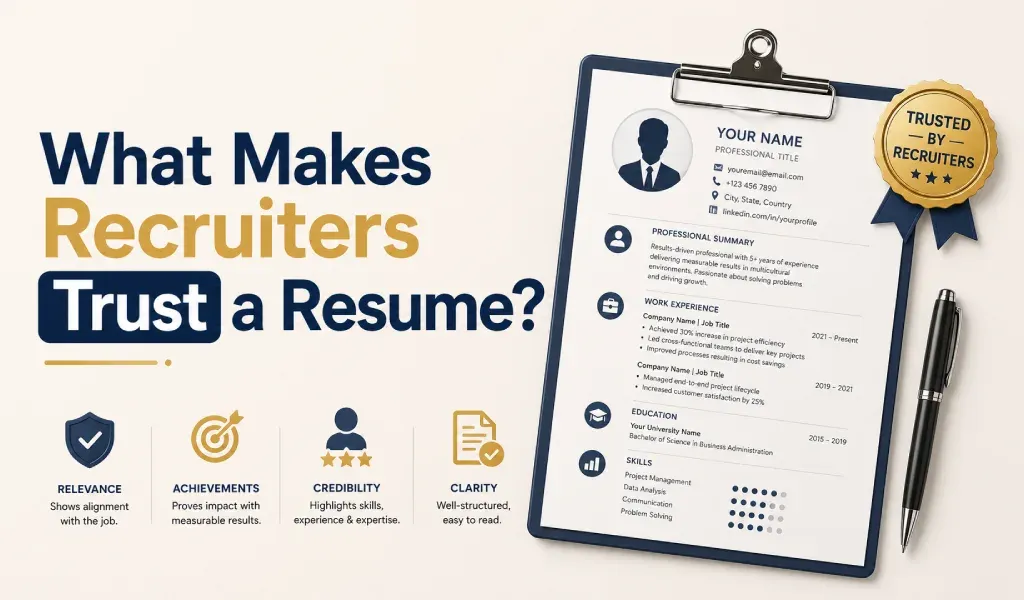
Recruiters trust a resume when it feels clear, honest, relevant, and easy to verify. That is the short answer. A trusted resume does not need fancy graphics. It does not need exaggerated claims. And it certainly does not need complicated language. It needs to make sense.
Recruiters review many resumes every day. They quickly notice when a resume feels genuine. They also notice when something feels unclear, copied, or too good to be true.
Trust starts with small details. A clean resume format. Consistent dates. Relevant experience. Real achievements. Natural language. No obvious errors.
When these things come together, a recruiter feels more confident about the person behind the resume.
Here is what actually makes recruiters trust a resume.
Clear Information
A professional resume should never make a recruiter search for basic information.
Your name should be easy to find.
Your contact details should be clear.
Your work experience should follow a logical order.
Your skills should be relevant to the job.
The easier your resume is to understand, the more trustworthy it feels.
Confusing layouts create doubt. Recruiters may wonder whether you are hiding something or simply lack attention to detail.
A simple resume format often works better than an overly creative one. Clarity builds confidence.
Honest Experience
One of the fastest ways to lose a recruiter's trust is to exaggerate.
You may feel pressure to make your experience sound more impressive. That is understandable. But there is a difference between presenting your work well and making claims you cannot support.
For example:
“Helped manage social media accounts” is believable but weak.
“Managed social media campaigns and increased engagement by 35%” is stronger.
The second version is more convincing because it includes a clear result. However, only use numbers you can explain.
If a recruiter asks how you increased engagement by 35%, you should have a real answer. A trusted resume is confident without being unrealistic.
Consistent Dates
Dates matter more than many job seekers realize.
Recruiters look at:
- Employment dates
- Education dates
- Promotion timelines
- Career gaps
- Overlapping roles
Small inconsistencies can create questions.
For example, your resume may say you worked at a company until March, while your LinkedIn profile says June.
That may be an innocent mistake. But the recruiter does not know that. Check every date before submitting your job application.
Your resume, cover letter, LinkedIn profile, and application form should tell the same story. Consistency creates credibility.
Relevant Experience
A recruiter does not need to know everything you have ever done. They need to know why you are a good fit for the current role. That is why relevant experience builds trust faster than a long list of unrelated jobs and responsibilities. Imagine you are applying for a digital marketing role.
Your resume should highlight:
- SEO
- Content marketing
- Social media
- Email campaigns
- Analytics
- Paid advertising
A part-time job from eight years ago may not need five bullet points. Focus on what matters now.
A targeted resume shows that you understand the role. It also tells the recruiter that you made an effort. Generic resumes are easy to spot.
Real Achievements
Responsibilities tell recruiters what you were supposed to do.
Achievements show what you actually did. Compare these two resume bullet points:
“Responsible for customer support.”
And:
“Handled 40+ customer queries daily while maintaining a 95% satisfaction rating.”
The second one feels more credible. It gives context, shows scale and also gives the recruiter something specific to discuss during an interview.
Whenever possible, add measurable achievements to your work experience.
You can use:
- Percentages
- Revenue
- Time saved
- Costs reduced
- Projects completed
- Customers helped
- Team size
- Growth achieved
Do not force numbers into every sentence. Use them where they add real meaning.
A Natural Summary
A professional resume summary should sound like a person wrote it. Many resume summaries are full of empty phrases.
“Highly motivated, dynamic, results-driven professional with a proven track record of excellence.”
What does that actually tell a recruiter?
Very little.
A better professional summary is specific.
For example:
“Digital marketing specialist with four years of experience in SEO, content strategy, and paid campaigns. Helped B2B brands grow organic traffic and generate qualified leads.”
This version is easier to trust. It tells the recruiter what the candidate does and where their experience lies. Keep your resume summary short. Three or four lines are usually enough.
Relevant Skills
A long list of random skills does not make a resume stronger. It can do the opposite. If you list every popular skill, recruiters may question whether you actually have experience with all of them.
Choose skills that match the job description.
For a software developer, these might include programming languages, frameworks, databases, and development tools.
For a graphic designer, they may include design software, branding, typography, and UI design.
For a fresh graduate, they may include relevant technical skills, academic projects, internships, and transferable skills.
Your skills section should support the rest of your resume.
If you list “Project Management” as a key skill, your work experience should show where you used it. That connection builds trust.
ATS-Friendly Formatting
A resume should work for both recruiters and Applicant Tracking Systems. Many companies use ATS software to organize and filter job applications.
An ATS-friendly resume usually has:
- Clear section headings
- Simple fonts
- Logical formatting
- Relevant resume keywords
- Standard job titles
- Easy-to-read content
Avoid unnecessary design elements that make information difficult to scan. Your resume can still look modern. It just needs to remain functional.
A professional resume template should help recruiters find information quickly. It should not distract them from your experience.
Keywords That Fit
Resume keywords matter. But keyword stuffing does not work. If a job description repeatedly mentions “project management,” “stakeholder communication,” and “budget planning,” those terms may be important.
Use them if they genuinely match your experience. Do not add skills you do not have just to pass an ATS resume checker. The best ATS-friendly resume is still an honest one. Relevant keywords help your resume get discovered. Real experience helps you get the interview. You need both.
No Unexplained Gaps
Career gaps are common. People take breaks for many reasons. A gap does not automatically make a resume untrustworthy. The problem starts when dates feel hidden or manipulated. If you have a significant career gap, you can address it briefly when relevant.
You may have spent that time:
- Studying
- Freelancing
- Caring for family
- Building a business
- Learning new skills
- Working on personal projects
You do not need to share private details. Just keep your timeline clear. Honesty is usually better than trying to hide an obvious gap.
Error-Free Writing
Spelling mistakes can damage trust quickly. A recruiter may forgive one small typo. Several errors are different. They suggest that the resume was not reviewed carefully. Before sending your resume, check:
- Spelling
- Grammar
- Punctuation
- Capitalization
- Job titles
- Company names
- Contact details
Read your resume aloud. You will often catch awkward sentences that are easy to miss on screen. Also check your email address and phone number. A perfect resume is useless if the recruiter cannot contact you.
A Professional Design
A trusted resume looks organized. It does not need to look expensive. Use a clean resume template with enough white space. Keep font sizes consistent. Use bold text carefully. Make section headings easy to identify. Avoid using too many colors.
A professional resume design helps the recruiter focus on your value. The goal is not to impress people with decoration. The goal is to make your information easy to read.
A Matching Cover Letter
A strong cover letter can make your resume more believable. It gives context that a resume cannot always provide. Your resume shows what you have done. Your cover letter explains why it matters for the role.
A personalized cover letter can answer questions like:
Why are you interested in this job?
Why are you changing careers?
Why does your experience fit the company?
What value can you bring?
Avoid sending the same generic cover letter with every application. A good cover letter should feel connected to both the job description and your resume.
A Human Voice
AI tools have changed resume writing. They can help job seekers write faster, improve structure, and avoid common mistakes. But there is one risk. A resume can start sounding generic. Recruiters often see the same phrases again and again.
“Results-driven professional.”
“Proven track record.”
“Passionate team player.”
These phrases are not always wrong. But too many of them can make your resume feel impersonal. Use AI as a writing assistant, not as a replacement for your own experience. Add real details. Use specific examples.
Make sure every claim sounds like something you could explain naturally in an interview. That is how an AI-generated resume becomes a credible, professional resume.
LinkedIn Consistency
Recruiters may check your online presence. Your LinkedIn profile does not need to copy your resume word for word. But the main facts should match.
Check your:
- Job titles
- Employment dates
- Company names
- Education
- Major achievements
Large differences can create unnecessary doubt. Think of your resume and LinkedIn profile as two versions of the same professional story. They should support each other.
Proof of Work
In some industries, proof matters more than claims. A designer can share a portfolio. A developer can link to projects. A writer can provide published samples. A marketer can mention campaign results. A freelancer can show relevant client work. You do not need to attach everything to your resume.
But when proof is available, make it easy to find. Evidence builds trust.
Use AI Carefully
Creating a professional resume from scratch can be difficult. You may know your experience well but struggle to describe it. You may also be unsure about resume formatting, professional summaries, cover letter structure, or ATS-friendly keywords.
This is where Cover Letter AI & Resume Maker can help.
The app is designed to help job seekers create professional resumes and personalized cover letters more efficiently.
You can use it to:
- Create a professional resume
- Generate a personalized cover letter
- Improve resume wording
- Organize work experience
- Build an ATS-friendly resume
- Choose professional resume templates
- Edit job application documents
- Save time during the job search
The important part is personalization. After generating your resume or cover letter, review it. Add your real achievements. Check your dates. Remove anything that does not sound like you. Make sure every statement is true.
The best AI resume builder should help you present your real experience more clearly. It should never invent a career for you.
What Recruiters Distrust
Recruiters become cautious when they see obvious warning signs.
These include:
- Unrealistic achievements
- Conflicting employment dates
- Too many unexplained buzzwords
- Skills with no supporting experience
- Poor grammar
- Fake qualifications
- Generic job descriptions
- Unclear career timelines
- Overly complicated resume designs
One issue may not ruin your chances. But several together can make a recruiter question the entire application. Trust is built through consistency. Every section should support the same professional story.
Before You Apply
Before submitting your next job application, ask yourself a few questions.
Does my resume clearly show what I do?
Are my dates accurate?
Can I explain every achievement?
Do my skills match my experience?
Is my resume relevant to this specific job?
Does my cover letter support my resume?
Would I feel comfortable discussing every claim in an interview?
If the answer is yes, your resume is probably on the right track.
Final Thoughts
What makes recruiters trust a resume?
Clarity.
Consistency.
Relevance.
Honesty.
Evidence.
A trusted resume does not try too hard to impress. It simply presents the candidate's real value in a clear and professional way.
Use a clean resume format. Include relevant skills. Show measurable achievements. Add the right resume keywords. Keep your employment history consistent. Pair your resume with a personalized cover letter.
Most importantly, make sure the document sounds like you.
Tools such as Cover Letter AI & Resume Maker can make resume writing and cover letter creation faster. They can help with structure, wording, formatting, and professional presentation.
But your real experience is what creates trust. A recruiter should finish reading your resume with one clear feeling:
“This person makes sense for the role.”
That is what a successful resume needs to achieve.