 Cover Letter AI & Resume Maker
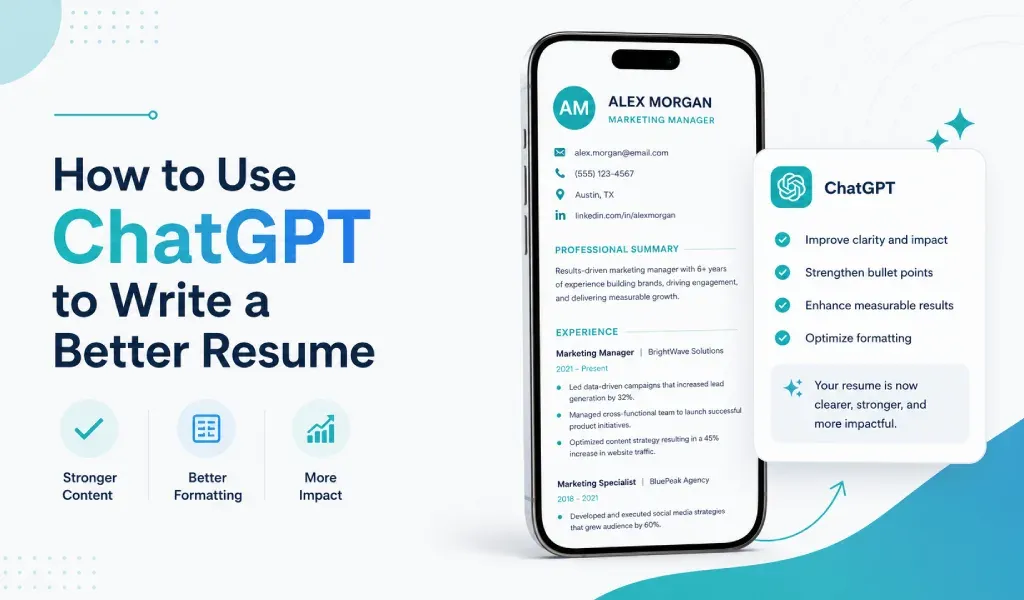
ChatGPT can improve a resume you already have: it can rewrite weak bullets, draft a summary and suggest keywords from a job post. It only knows what you tell it, so give it your real roles, dates and results, tell it to use only those facts, and check every line before you send the resume.
There is a right way and a wrong way to do this. Here are the steps, the prompts and the mistakes to avoid.
Key Takeaways
- ChatGPT works best on material you supply: your current resume, the job post and your real achievements.
- It can invent details. Forage's tests found it claimed a QuickBooks skill the prompt never mentioned, and Northern Kentucky University's career services warns it may guess at your experience or suggest numbers that do not reflect your results.
- Tell it to use only the facts you provide, then verify every date, title, tool and number.
- Keep the final layout plain. UNC's career center advises avoiding graphics, tables, columns and text boxes.
- Protect your data. NKU advises removing identifying details before you share a resume, and OpenAI says Temporary Chats are not used for model training.
Why People Use ChatGPT for Resume Writing
Writing about yourself is difficult. Many job seekers know they have valuable experience but struggle to present it. ChatGPT can help by generating resume content, improving wording, rewriting job descriptions, drafting summaries, suggesting skills and drafting cover letters. Instead of starting from a blank page, you start from a draft and customize it.
What ChatGPT Can Do for Your Resume
ChatGPT is not a replacement for your experience, and it cannot supply real achievements. It can help you describe the ones you have more clearly. The example below uses placeholders, so replace them with figures you can support.
- Before: Responsible for managing social media accounts.
- After: Managed [number] social media accounts and published [number] posts a week, reporting [metric] to the team.
If you let the tool choose the result for you, it may invent one. That is the risk to manage throughout this guide.
Start With Your Current Resume
Before you open ChatGPT, gather your information: your current resume, previous job titles, work experience, education, certifications, skills and achievements. The quality of your input shapes the quality of the output. NKU's career services advises giving the tool as much specific detail as you can, while removing identifying details such as your name and contact information before you share your resume. You can add them back afterward.
Use ChatGPT to Create a Professional Summary
A resume summary sits at the top of the page and gives recruiters a quick overview. Here is a prompt:
Write a professional resume summary for a marketing specialist with [number] years of experience in digital marketing, content creation and social media management. Use only the facts I provided.
ChatGPT can produce a solid starting point. Edit it so it matches your voice and goals. For more examples, see how to write a strong resume summary.
Improve Your Work Experience
Many resumes list duties when recruiters want achievements. Paste your existing bullets and ask:
Rewrite these bullets to be achievement-focused. Use only the facts I provide. Do not add numbers, tools or employers I did not mention.
Keep everything truthful. Never claim an achievement you did not accomplish.
Generate Better Resume Bullet Points
Recruiters scan resumes quickly, and well-written bullets make key information easier to find. You can ask for several options and choose the best:
Give me five bullet options for a customer service representative role, based only on these facts: [your facts].
Pick the ones that are true, then add your own numbers where you can support them.
AI can speed up a first draft, but it can also invent details. If you use Cover Letter AI & Resume Maker, check every date, title and number against your real record.
Optimize Your Resume for ATS
Applicant tracking systems are common at large employers. Jobscan's 2026 count found a detectable ATS at 97.4% of Fortune 500 companies, and Workable describes resume parsing as extracting details such as name, email, degrees, skills and work experience.
ChatGPT can help you identify keywords. Paste the job description and ask for the important skills and phrases, then use only the ones that match your real experience. Ohio Northern University's career center advises putting keywords inside achievement bullets and using the exact job title you are seeking, and West Virginia University's career center adds that a keyword-filled skills section alone is not enough.
You may have read that a missing keyword means a human never sees your resume. That is not well supported. In an Enhancv study reported by The HR Gazette in November 2025, only 2 of 25 U.S. recruiters said they configure content-based auto-rejection, though a sample of 25 is small. The safer risk is layout: UNC advises avoiding graphics, tables, columns and text boxes, which can interfere with ATS scanning. See our guide to the ATS-friendly resume.
Match Your Resume to a Specific Job
A common mistake is using the same resume for every application. ChatGPT can help you customize one for each role:
Tailor these bullets for the job below. Keep the facts unchanged and reorder them by relevance. [Paste bullets and job post]
For a full five-step method, see how to tailor your resume with AI.
Use ChatGPT to Identify Missing Skills
Sometimes your experience is stronger than you think. Ask:
Based on this work experience, what transferable skills could I include on my resume? Mark which ones are directly supported by the text.
This helps students, fresh graduates, career changers, freelancers and remote workers. Treat the answer as a list of prompts to check against what you have actually done.
Create a Better Skills Section
Recruiters and ATS software both read the skills section. ChatGPT can suggest skills for a target role, but you should compare them with your real abilities and include only the ones you can back up. ONU advises listing only skills you can document. Our guide to showing your skills on a resume explains how to pair each skill with proof.
Use ChatGPT for Cover Letter Writing
A strong resume works better with a tailored cover letter. In a ResumeGo field experiment, tailored letters had a 53% higher callback rate than applications with no letter, though ResumeGo sells resume services, so read it as one data point.
ChatGPT can draft a letter from the job description, your experience and company information, but a short prompt tends to produce a generic one. Forage's testers called ChatGPT's letters polished but generic. We ran our own test, and our write-up of what ChatGPT got wrong in a cover letter shows where it invented details.
Common Mistakes When Using ChatGPT
Copy-Pasting Everything
Do not paste AI output without reviewing it. In TopResume's May 2025 test, 33.5% of 600 U.S. hiring managers correctly spotted AI-generated resumes. Always personalize the final version.
Using Generic Language
Phrases such as "hard-working professional," "team player" and "results-driven individual" appear on many resumes. Dice's experts name generic buzzwords as a warning sign. Add specific details whenever you can.
Making False Claims
Never exaggerate achievements or invent experience. Employers check, and a claim you cannot explain is a risk.
Ignoring Layout Requirements
An impressive-looking draft can still be hard for software to read. Use a plain layout and check the exported file.
Keep Your Data Private
Resumes contain personal details. NKU advises removing identifying information, such as your name and contact details, before you share your resume with ChatGPT. OpenAI's Help Center says ChatGPT improves by training on conversations unless you turn it off, using the "Improve the model for everyone" setting under Settings > Data Controls, and that Temporary Chats are not used for training and are deleted from its systems within 30 days. Settings change, so check the current version before you paste a full resume.
Why Human Editing Still Matters
AI can help you write a better resume, but human judgment still matters. You know your career story better than any tool does. The best resumes combine your real experience, AI assistance and personal customization. Use ChatGPT as an assistant, not a replacement.
When a Dedicated Tool Makes More Sense
ChatGPT gives you text, and you still have to format, organize and export the document. A dedicated app handles more of that. Cover Letter AI & Resume Maker writes AI cover letters from the details you enter, including the role, company, tone and key skills, has resume templates and fonts, and exports PDF or Word files. It is free to download, with in-app purchases for some features, and it runs on iPhone and iPad only. For a side-by-side look at the trade-offs, see AI resume builder vs ChatGPT.
Related Reading
- AI Resume Builder vs ChatGPT: Which Is Better for Resumes?: which tool fits which part of your resume.
- AI Resume Writing Tips: Edit AI Drafts So They Sound Human: edit AI drafts so they sound like you.
- How to Tailor Your Resume to a Job With AI (5 Steps): tailor one resume to many postings.
- I Asked ChatGPT to Write My Cover Letter: What It Got Wrong: what a real ChatGPT cover letter got wrong.
Sources: Forage, ChatGPT cover letter tests (published December 15, 2022; updated May 31, 2024); Northern Kentucky University Career Services, guide to using ChatGPT to improve resumes and cover letters; OpenAI Help Center, Data Controls FAQ; Jobscan, Fortune 500 ATS usage report (August 20, 2026); Workable, "What is resume parsing? How an ATS reads a resume" (page dated September 2023); UNC Student Affairs Career Center, "UNC Resume Guide for Students"; Ohio Northern University Polar Careers, applicant tracking system resume guide; West Virginia University Career Services Center, "How to tailor your resume to impress employers"; The HR Gazette, report on the Enhancv recruiter study (November 11, 2025); ResumeGo, Cover Letters: Just How Important Are They? (field experiment, 2019 to 2020); TopResume, AI in hiring survey (fielded May 15 and 16, 2025); Dice Insights, Stop Letting AI Sabotage Your Resume (January 8, 2026). Prompts and examples use placeholders.
Want AI to handle the first pass? Cover Letter AI & Resume Maker writes cover letters from the details you enter and builds resumes from templates. You stay responsible for the facts. Free to download from the App Store for iPhone and iPad, with in-app purchases for some features. AI drafts can contain mistakes, so read and edit every line before you send it.
Frequently Asked Questions
Can ChatGPT write a resume for me? It can draft and edit one, but it only knows what you tell it. Give it your real roles, dates and results, then check the output line by line. Anything you did not supply may be invented, so verify every detail before you use it.
Is it safe to put my personal details into ChatGPT? Remove identifying details first. NKU advises leaving out your name and contact information. OpenAI says Temporary Chats are not used for training, and you can turn off "Improve the model for everyone" under Settings > Data Controls. Settings change, so check them before you paste a full resume.
Can an ATS detect a ChatGPT-written resume? Workable describes an ATS as parsing details such as name, email, degrees, skills and experience. Whether anyone runs a separate AI detector varies, and detectors are unreliable. The bigger risk is generic language that people notice, so edit the draft to reflect your own experience and voice.
What is a good ChatGPT prompt for a resume? Give it the job post, your real experience and a clear rule. For example: "Rewrite these bullets for this job. Use only the facts I provided. Do not add numbers, tools or employers I did not mention. Keep each bullet under 25 words." Specific limits produce better drafts than a generic request.
Is ChatGPT or a resume builder better for resumes? ChatGPT is flexible for wording, while a resume builder handles layout, templates and exporting. Many people draft text in one and format in the other. Our comparison of AI resume builders and ChatGPT covers the trade-offs in detail.